Authored by: Fabiano Colet, Tatiane S. Silva, Seth Naeve, and Shawn P. Conley
It’s August, and soybean reproductive stages are in full swing across the Midwest. This time of year, farmers start worrying about soybean flower, pod, and seed abortion, which is often viewed as a direct loss of potential yield that can and should be prevented or mitigated. But before trying to save every pod and seed, we need to ask: is there really a way to save flowers, pods and seeds from dropping into the ground? If we do, will we increase yields? The answers are: It depends.
Understanding source vs. sink dynamics in soybeans
Soybean seed yield is the result of a balance between the source (photosynthates produced mostly by leaves) and the sink (flowers, pods, and seeds accumulating those sugars). While severe, prolonged stress can cause excessive flower, pod, and seed abortion that reduces yields, abortion also occurs naturally under ideal, non-stressed growing conditions.
Under these optimal conditions, high-yielding soybeans in the Midwest are primarily source-limited rather than sink-limited. To put it simply, the plant naturally creates more sink capacity than its source can ultimately support by producing more flowers and pods than it can fill, triggering natural abortion. Consequently, high rates of photosynthesis during reproductive stages yield a large number of seeds and higher overall yields, whereas low rates result in fewer seeds and lower yields.
What the research says
Efforts to optimize yield potential should focus on increasing source capacity during the most critichttps://badgercropnetwork.com/wp-content/uploads/2026/08/Figure-1-300×150.pngal period for yield determination: from the R4 (full pod) to R7 (beginning maturity) growth stages (Cerrudo & Naeve, 2025). Specifically, practices should aim to minimize stress on the leaves during this key window.
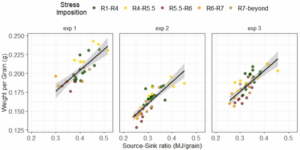
Cerrudo and Naeve (2025) reported a strong association between soybean seed weight and the source-sink ratio during the grain filling period across three field experiments conducted in 2022 and 2023 in St. Paul, MN (Figure 1). They found that seed weight was driven by the relationship between the available photosynthates (source) during seed fill stage and the total number of seeds the plant was holding.
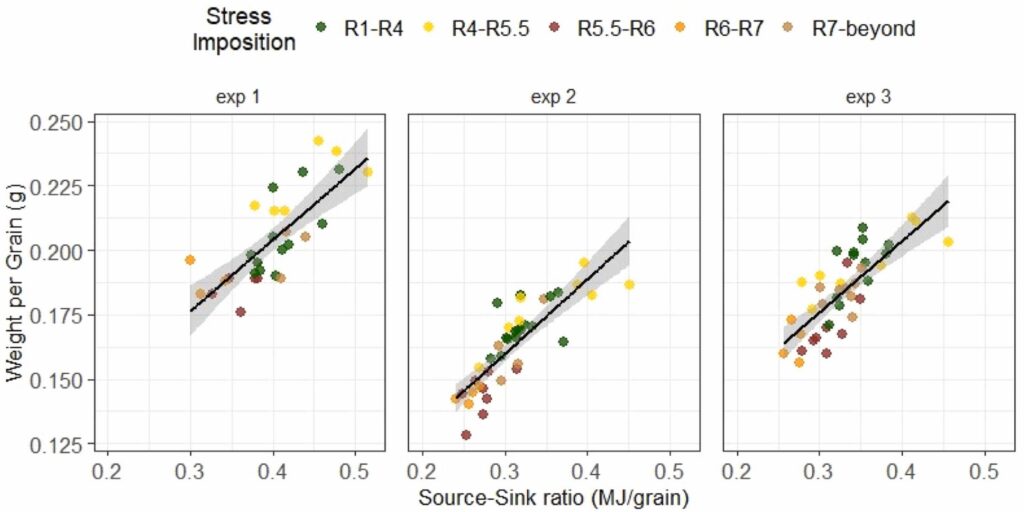
Fig. 1. Relationship between soybean seed weight and the balance between the plant’s ability to produce energy (the “source”) and the number of seeds that need to be filled (the “sink”) in three experiments conducted in St. Paul, Minnesota, during 2022 and 2023 (Source: Cerrudo & Naeve, 2025). The source–sink ratio during grain filling was estimated by dividing the total sunlight energy received between the R4 and R7 growth stages by the number of seeds produced per acre.
Spend your input dollars wisely
Farmers are often bombarded with marketing related to late-season foliar biostimulants, foliar fertilizers, plant growth regulators, or stress-mitigation products that claim to “stop flower and pod drop” or increase seed size. However, even if these products were successful, saving extra flowers or pods will not increase yield potential if the canopy lacks the photosynthetic capacity (source) to fill those additional seeds. In fact, pushing more sink demand onto a source-limited plant can lead to smaller seeds or delayed abortion later in the season. Overall, under optimal field conditions, soybean yield is limited by source constraints during the reproductive stages (R3–R6), rather than a failure of the plant to set enough seeds.
Field strategies to maximize source potential
Since Midwestern soybeans often grow under optimum growing conditions and are primarily source-limited, management practices should focus on maximizing canopy light interception and protecting leaf health throughout the season:
- When soil and field conditions allow, plant earlier to build canopy cover fast. This maximizes total light capture, boosts the photosynthate supply (source) needed during flower, pod, and seed (sinks) development, and extends the seed filling period.
- Choose adapted soybean varieties with a maturity group that fully utilizes your region’s growing season, aiming for maturity that best utilizes the full fall season without hastening maturation and terminating seed filling.
- Scout fields regularly for foliar diseases and defoliation from insects. Implement integrated pest management to maintain a healthy canopy efficiently throughout the critical period.
- Avoid late-season nutrient deficiencies and water stress whenever possible.
References
Carrera, C. S., Savin, R., & Slafer, G. A. (2024). Critical period for yield determination across grain crops. Trends in Plant Science, 29(3), 329-342. https://doi.org/10.1016/j.tplants.2023.08.012
Cerrudo, A., & Naeve, S. L. (2025). Redefining soybean critical period for yield determination. Field Crops Research, 321, Article 109662. https://doi.org/10.1016/j.fcr.2024.109662
Egli, D. B., & Bruening, W. P. (2006). Fruit development and reproductive survival in soybean: Position and age effects. Field Crops Research, 98(2–3), 195–202. https://doi.org/10.1016/j.fcr.2006.01.005
Egli, D. 2025. What Limits Yield – The Source or the Sink? Does it Matter? Kentucky Field Crops News, Vol 1, Issue 2. University of Kentucky, February 14, 2025. https://graincrops.mgcafe.uky.edu/articles/what-limits-yield-source-or-sink-does-it-matter
Monzon, J. P., La Menza, N. C., Cerrudo, A., Canepa, M., Edreira, J. I. R., Specht, J., Andrade, F. H., & Grassini, P. (2021). Critical period for seed number determination in soybean as determined by crop growth rate, duration, and dry matter accumulation. Field Crops Research, 261, 108016. https://doi.org/10.1016/j.fcr.2020.108016