Damon Smith, Extension Field Crops Pathologist, Department of Plant Pathology, University of Wisconsin-Madison
Shawn Conley, State Soybean and Small Grains Specialist, Department of Plant and Agroecosystem Sciences, University of Wisconsin-Madison
As soybean harvest begins in Wisconsin, reports of poor seed quality are increasing. Farmers are submitting photos of discolored, chalky, shriveled, and sometimes heavily colonized seed. While several factors may be contributing to these issues, purple seed stain and Diaporthe seed decay are emerging as two of the most common concerns following the wet conditions experienced during late summer and fall of 2026.
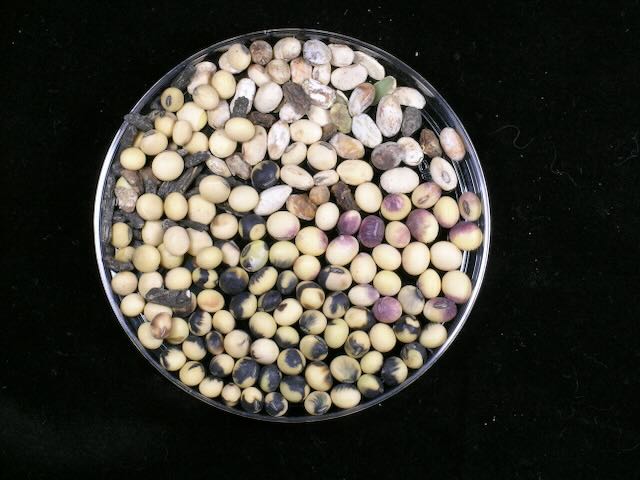
Figure 1. Various soybean seed issues including purple seed stain, Diaporthe seed decay, white mold and other disorders. Photo Credit: Craig Grau, University of Wisconsin-Madison.
Purple Seed Stain Increasing in 2026
Purple seed stain, caused by Cercospora species, has become more noticeable across the Midwest this year (Figure 1). The disease produces a distinctive purple discoloration of soybean seed that can range from small spots to extensive staining of the entire seed coat.
Although visually striking, purple seed stain is generally considered a seed quality issue rather than a yield-limiting disease. The most significant impacts are economic. Affected grain may receive a special grade designation under USDA standards and can face discounts or rejection in food-grade markets where appearance is important. The pathogen is not known to produce toxins of concern for livestock feed.
The increase in purple seed stain during 2026 is likely linked to warm, wet conditions during seed development and maturation. Extended periods of rainfall, high humidity, and frequent dew favor infection and symptom development on seed.
Purple Seed Stain Does Not Always Equal Cercospora Leaf Blight
Purple seed stain is often associated with Cercospora leaf blight (CLB), another disease caused by several Cercospora species. Cercospora leaf blight typically develops during reproductive growth stages and causes bronzing or purpling of upper canopy leaves, leathery foliage, petiole lesions, and, in severe cases, premature defoliation.
Because the same group of fungi can be associated with both diseases, it has long been assumed that fields with leaf blight would also have purple seed stain. However, observations from 2026 and recent research suggest the relationship is often weak. Many fields with substantial seed staining have shown little or no evidence of foliar CLB.
These observations indicate that environmental conditions during seed development may be more important for purple seed stain than the presence of visible foliar symptoms. As a result, growers should evaluate seed quality independently of Cercospora leaf blight severity when assessing potential impacts.
Research has also shown that foliar fungicide applications during reproductive growth stages generally provide limited benefit for reducing purple seed stain.
Diaporthe Seed Decay Also a Concern
In addition to purple seed stain, Diaporthe seed decay has been observed in some soybean fields across the Midwest. Like purple seed stain, this disease is favored by wet weather during pod fill and seed maturation.
Diaporthe seed decay is characterized by cracked, shriveled seed, reduced germination, poor seed vigor, and, in some cases, reduced test weight and oil content (Figure 2). Infection occurs through soybean pods during reproductive growth and can continue as long as seed moisture remains relatively high. Consequently, delayed harvest often increases the risk of seed decay and quality losses.
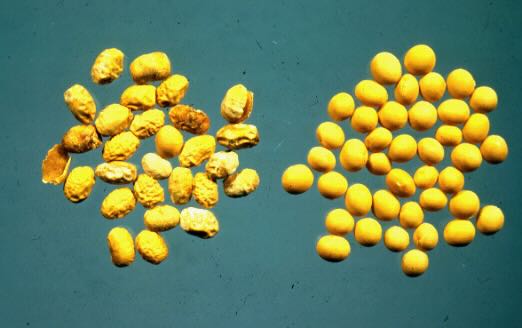
Figure 2. Soybean seed infected by Diaporthe spp. on the left compared to healthy soybeans seeds on the right. Photo Credit: Craig Grau, University of Wisconsin-Madison.
Related diseases caused by Diaporthe species, including pod and stem blight, may also contribute to premature plant death and reduced seed fill under favorable conditions.
Management relies primarily on resistant varieties, crop rotation, and practices that reduce inoculum. When wet weather occurs near maturity, timely harvest remains one of the most effective strategies for preserving seed quality. While foliar fungicides applied between R3 and R5 may reduce infection in some situations, improvements in yield and seed quality are often inconsistent.
Summary
The widespread seed quality issues being observed in 2026 appear to be driven largely by persistent wet weather during seed maturation. Purple seed stain and Diaporthe seed decay are becoming increasingly common and may reduce grain marketability even when yield impacts are minimal. As harvest progresses, farmers should carefully assess seed quality and prioritize timely harvest where field conditions allow.
References
- Hartman, G. L., Rupe, J. C., Sikora, E. J., Domier, L. L., Davis, J. A., & Steffey, K. L. (Eds.). 2016. Compendium of Soybean Diseases and Pests (5th ed.). APS Press.
- Mueller, D. S., Wise, K. A., Sisson, A. J., Smith, D. L., Sikora, E. J., Bradley, C. A., & Robertson, A. E. 2016. A Farmer’s Guide to Soybean Diseases. The American Phytopathological Society.
- Science for Success – Purple Seed stain on the Rise in 2026: https://soybeanscienceforsuccess.org/2026/10/02/purple-seed-stain-on-the-rise-in-2026/.