Authored by: Adam Roth, Spyros Mourtzinis, Tatiane Severo Silva, Mark Kendall, and Shawn Conley
Short and S-Wheat:
- 15-inch row spacing did not result in a significant yield penalty or increased weed pressure across five location-years.
- Increasing seeding rate can improve yield, but gains level off beyond an optimal rate of 1.5 millions seeds per acre
- Higher seeding rates were associated with reduced grain protein levels
Introduction
For growers looking to plant winter wheat without investing in a grain drill, 15-inch row spacing offers a practical alternative. While traditional 7.5-inch rows are generally reported to deliver higher yields than wider row spacings, 15-inch rows may still perform respectably, especially when paired with the correct seeding rate. Wider rows may encourage more tillering and allow for intercropping with soybeans, making them a flexible option for farms already equipped with planters or air seeders. However, wider rows can create more opportunities for weed competition.
| Table 1. Row spacings and seeding rates | |
| Row spacing inches | Million seeds/acre |
| 7.5 | 0.75 |
| 15 | 1.00 |
| 1.25 | |
| 1.50 | |
| 1.75 | |
| 2.00 | |
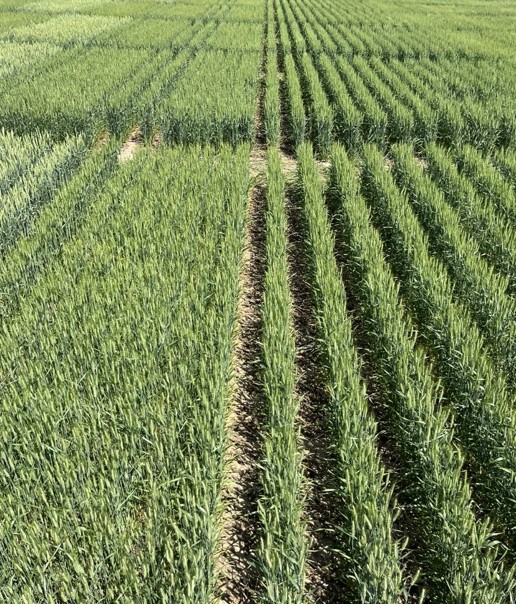
Image 1. Picture of wheat row spacings: 7.5 inch (left) 15 inch (right)
The objective of this research is to evaluate the impact of narrow (7.5-inch) versus wide (15-inch) row spacing in winter wheat planted at different seeding rates (Table 1) on grain yield, test weight, and protein levels. FS 745 winter wheat was planted at one location in 2024 and four locations in 2025 (Table 2). The same custom plot planter was used for both row spacings to eliminate equipment-related variability. Fertility management followed University of Wisconsin-Extension guidelines. In spring, Huskie herbicide was applied for weed control. Grain yield, moisture, test weight, and protein content were measured in the field using electronic sensors integrated into the plot harvester.
| Table 2. Trial location information | ||
| Location | Planting date | Harvest date |
| Arlington, WI | 9/20/2024 | 7/15/2025 |
| Arlington, WI | 9/26/2025 | 7/14/2026 |
| Fond Du Lac, WI | 9/30/2025 | 7/15/2026 |
| Waterloo, WI | 10/1/2025 | 7/13/2026 |
| Random Lake, WI | 10/13/2025 | 7/20/2026 |
Results
Across all experiments, optimum seeding rate was 1.5 million seeds/ac for both row spacings (Fig 1). This trend aligns with established seeding rate guidelines (Table 3). There is no strong evidence that on average, narrow rows resulted in greater yield than wide rows (p=0.1103). Higher seeding rates were also associated with reduced grain protein levels, possibly due to limited nitrogen availability within the plant. Increasing the seeding rate from 0.75 to 2.00 million seeds per acre resulted in a 0.3% reduction in grain protein concentration. Additionally, across all experiments, the average effect of both row spacing and seeding rate on test weight was not significant. Furthermore, no distinctions in weed pressure between the two row spacings were observed.
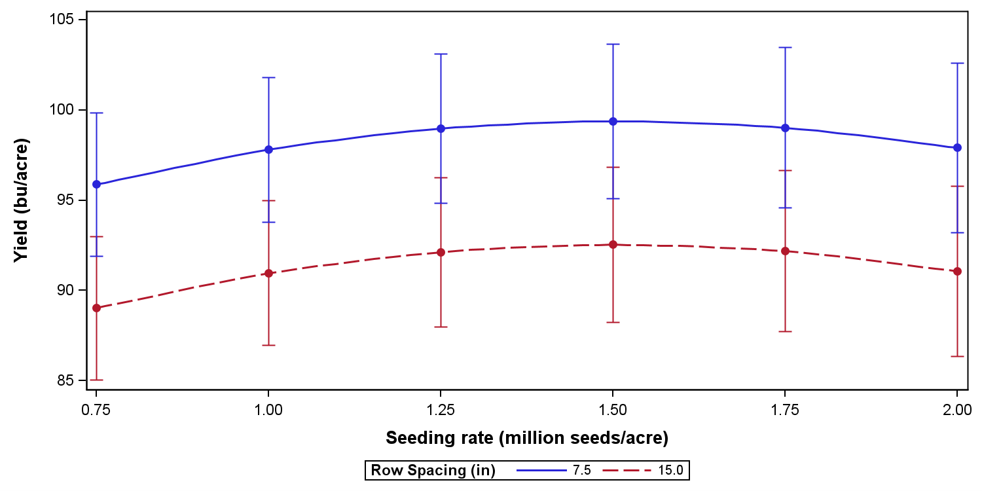
Figure 1. Winter wheat grain yield response to increasing seeding rates across five locations in 2025 and 2026 Wisconsin growing seasons.
| Table 3. Wisconsin Winter Wheat Seeding Rate Recommendations | ||||
|
Seeds/acre (million) |
Seeds/ft.2 |
Row width (in.) |
||
|
6 |
7 |
7.5 |
||
|
Seeds per foot of row |
||||
| 1.50 | 34.4 | 17.2 | 20.1 | 21.5 |
| 1.55 | 35.6 | 17.8 | 20.8 | 22.2 |
| 1.60 | 36.7 | 18.4 | 21.4 | 23.0 |
| 1.65 | 37.9 | 18.9 | 22.1 | 23.7 |
| 1.70 | 39.0 | 19.5 | 22.8 | 24.4 |
| 1.75 | 40.2 | 20.1 | 23.4 | 25.1 |
| Recommended seeding rate prior to Oct. 1 | ||||
| 1.80 | 41.3 | 20.7 | 24.1 | 25.8 |
| 1.85 | 42.5 | 21.2 | 24.8 | 26.5 |
| 1.90 | 43.6 | 21.8 | 25.4 | 27.3 |
| 1.95 | 44.8 | 22.4 | 26.1 | 28.0 |
| 2.00 | 45.9 | 23.0 | 26.8 | 28.7 |
| Recommended seeding rate Oct.1 to Oct.10 | ||||
| 2.05 | 47.1 | 23.5 | 27.5 | 29.4 |
| 2.10 | 48.2 | 24.1 | 28.1 | 30.1 |
| 2.15 | 49.4 | 24.7 | 28.8 | 30.8 |
| 2.20 | 50.5 | 25.3 | 29.5 | 31.6 |
| 2.25 | 51.7 | 25.8 | 30.1 | 32.3 |
| Recommended seeding rate after Oct.10 | ||||
| 2.30 | 52.8 | 26.4 | 30.8 | 33.0 |
| 2.35 | 53.9 | 27.0 | 31.5 | 33.7 |
| 2.40 | 55.1 | 27.5 | 32.1 | 34.4 |
| 2.45 | 56.2 | 28.1 | 32.8 | 35.2 |
| 2.50 | 57.4 | 28.7 | 33.5 | 35.9 |