Damon Smith, Extension Field Crops Pathologist, Department of Plant Pathology, University of Wisconsin-Madison
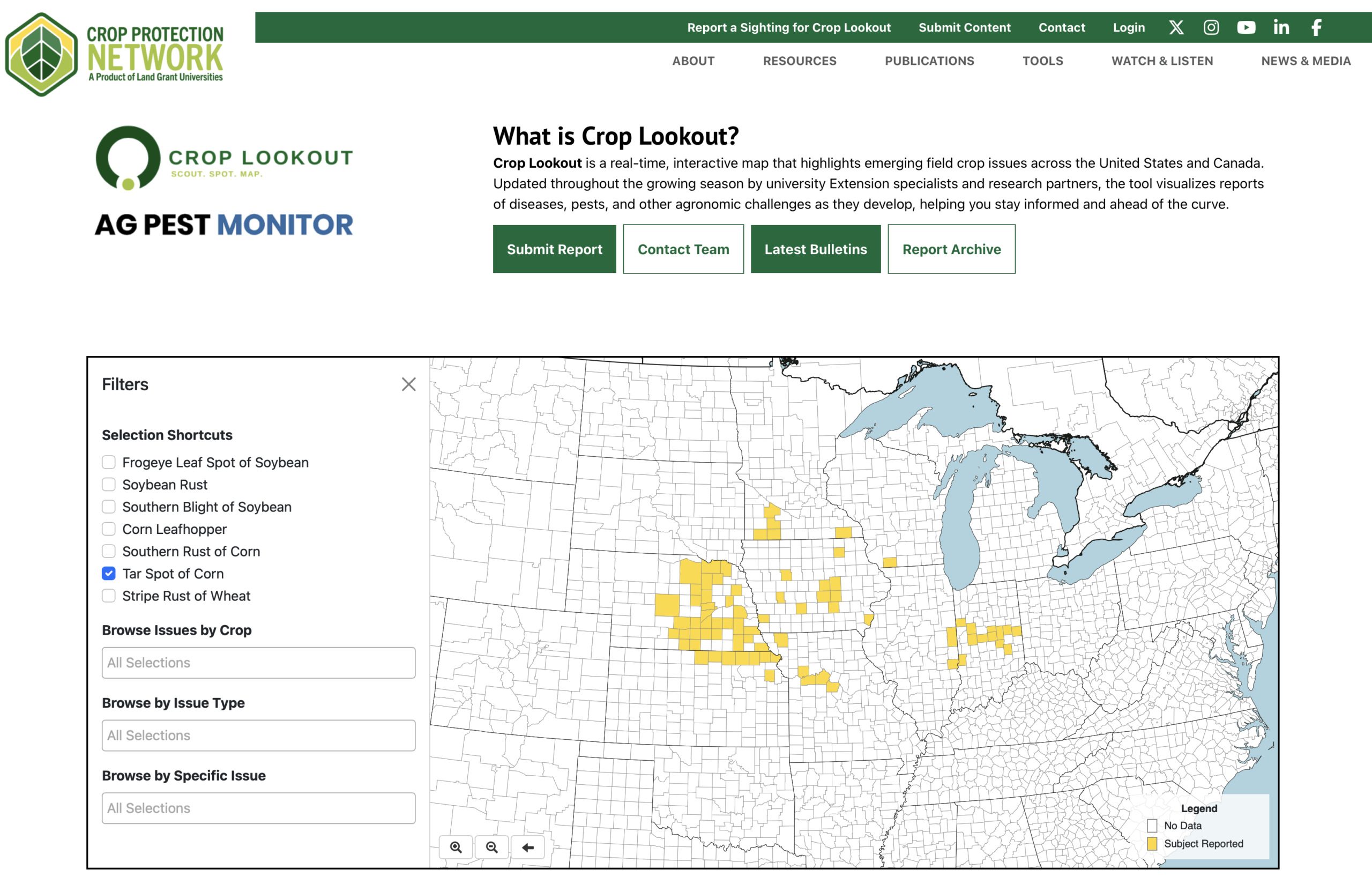
If you are like me, you have probably been keeping an eye on the CPN Crop Lookout Map watching southern states where southern rust of corn has already been confirmed this season. Following the significant impact of southern rust in parts of Wisconsin during 2025, it is understandable that many farmers and crop consultants are concerned about the possibility of the disease returning in 2026.
At the time of writing, southern rust has not been confirmed in Wisconsin. However, reports from southern states indicate that the disease is active and beginning to move northward. While this does not guarantee that southern rust will become a problem here, it does mean that now is an appropriate time to increase scouting efforts and remain informed about disease development in the region.
The most important message right now is simple: don’t panic, but do scout. Early detection remains one of the most valuable tools for making informed management decisions. As we move through the reproductive stages of corn development, regular field inspections will help identify whether southern rust arrives and whether management actions are warranted.
Grain yield loss from southern rust is typically greatest when the disease becomes established before the milk (R3) growth stage. This means the risk of substantial grain yield loss is lower if infection occurs late in the season as is typical in Wisconsin. However, southern rust can still accelerate canopy deterioration and may influence silage quality and harvest timing if it moves in in late August.
Southern rust can also affect plant health later in the season by contributing to premature leaf death and reduced standability. If southern rust is eventually detected in a field, that information may be useful when prioritizing harvest order this fall.
What Should You Be Looking For?
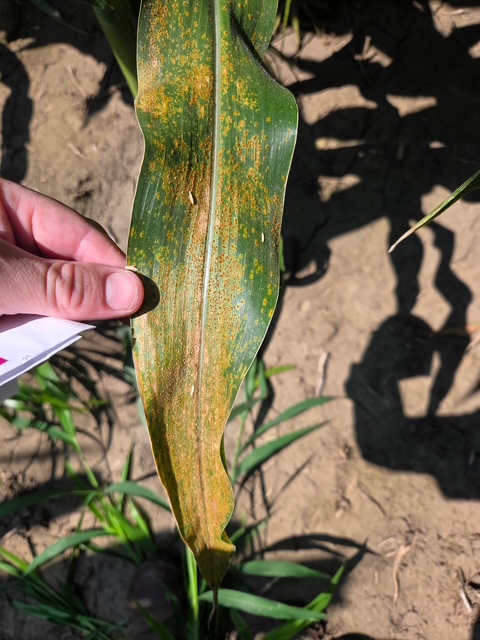
Figure 1. Southern rust on a corn leaf.
Southern rust is caused by the fungus Puccinia polysora. Symptoms differ from those of common rust routinely observed in Wisconsin. Southern rust pustules are generally smaller, more numerous, and often display a brighter orange to reddish-orange color (Fig. 1). The pustules typically develop on the upper leaf surface and tend to occur in dense clusters.
The disease develops most rapidly under conditions of high humidity and temperatures near 80°F. Unlike many foliar diseases, southern rust requires very little free moisture for infection to occur.
Because the pathogen cannot survive Wisconsin winters, spores must be carried into the state each year by wind currents from more southern regions where corn is actively infected. Historically, southern rust has been an infrequent disease in Wisconsin and, when it has occurred, infections often developed late enough in the season to limit economic impact. The widespread activity observed during 2025 serves as a reminder, however, that damaging outbreaks can occur when environmental conditions align, and the disease arrives early enough.
For that reason, farmers should continue monitoring regional disease reports and regularly scout fields, especially those planted to susceptible hybrids or those still at growth stages where yield impacts remain possible.
Management Considerations
Historically, host resistance played a major role in managing southern rust. However, the discovery of resistance-breaking races of the pathogen has reduced the effectiveness of resistance in many modern hybrids. As a result, most commercially grown hybrids should be considered susceptible.
Crop rotation and residue management provide little benefit for southern rust management because the pathogen cannot overwinter in Wisconsin. Instead, management focuses on monitoring disease movement, scouting fields, and determining whether fungicide applications are economically justified.
Fungicides can be highly effective when applied appropriately. Current efficacy ratings can be found in the CPN Fungicide Efficacy Tool. Fungicide decisions should be based on several factors, including:
- Whether southern rust has been confirmed in the field
- Corn growth stage (before R3?)
- Disease severity and spread
- Hybrid susceptibility
- Yield potential
- Weather forecasts favoring disease development
Because southern rust has not yet been detected in Wisconsin, prophylactic fungicide applications may not be warranted in many situations. Instead, farmers should focus on diligent scouting and use confirmed disease observations to guide management decisions.
If rust symptoms are observed and identification is uncertain, leaf samples can be submitted to the University of Wisconsin Plant Disease Diagnostic Clinic (PDDC). Samples should be placed in a sealed plastic bag with no additional moisture added. Diagnostic confirmation can help ensure management decisions are based on accurate disease identification.
Don’t Confuse Southern Rust with Common Rust
Common rust, caused by Puccinia sorghi, is present in Wisconsin nearly every year and rarely causes significant economic loss in field corn. Most hybrids grown in Wisconsin possess excellent resistance to common rust.
Common rust pustules are typically darker brick-red in color, more sparsely distributed across the leaf surface, and may be found on both upper and lower leaf surfaces. Pustules can also occur on husks and stalks. In contrast, southern rust produces smaller, brighter orange pustules that are usually concentrated on the upper leaf surface.
Several fields across Wisconsin already have low levels of common rust this season. Finding common rust should not automatically trigger concern or a fungicide application. Correct diagnosis remains critical before making management decisions.
The Bottom Line
Southern rust has not yet been detected in Wisconsin, but recent reports from the southern U.S. make this an excellent time to increase scouting efforts. The experience of 2025 reminds us that the disease can develop rapidly under favorable conditions. Regular field monitoring over the coming weeks will provide the information needed to make timely and economically sound management decisions if southern rust arrives.