Authored by: Shawn Conley, State Soybean and Small Grains Specialist, Adam Roth, Research Agronomist, and Damon Smith, State Field Crops Pathology Specialist
Top 9 winter wheat establishment recommendations:
- Variety selection: please see the 2026 WI Winter Wheat Performance Test
- Plant new seed (DO NOT plant saved seed).
- A fungicide seed treatment is recommended for winter wheat in WI, especially for seed damaged by Fusarium head blight (FHB).
- Cephalosporium stripe is increasing in occurrence in Wisconsin. Use the 2025 WI Winter Wheat Performance Test data to choose a wheat variety with good partial resistance to this disease.
- Wheat should be planted 1 to 1.5 inches deep regardless of planting date.
- Plant between September 20 and October 10.
- The target seeding rate for wheat planted from September 20th to October 1st is 1,750,000 seeds per acre.
- The optimal seeding rate for wheat planted after October 1st should be incrementally increased as planting date is delayed compensating for reduced fall tillering.
- Crop rotation matters.
Variety Selection
As with any crop, variety selection is the most important factor to consider in maximizing winter wheat yield and profitability. When choosing a winter wheat variety, several factors must be considered. These include winter survival, insect and disease resistance, lodging, test weight, and most importantly, yield. Since no variety is ideal for every location, it is important to understand the crop environment and pest complex that affects your specific region to maximize yield.
Yield is based on the genetic potential and environmental conditions in which the crop is grown. Therefore, by diversifying the genetic pool that is planted, a grower can hedge against crop failure. Select those varieties that perform well not only in your area, but across experimental sites and years. This will increase the likelihood that, given next year’s environment (which you cannot control), the variety you selected will perform well.
Test weight is also an important factor to consider when selecting a variety. The minimum test weight to be considered a U.S. #2 soft red winter wheat is 58 lb/bu. Wheat at lower test weights will be discounted. Environment, pests and diseases may greatly affect test weight; therefore, selecting a variety that has a high-test weight potential in your region is critical to maximizing economic gain. Test weight discounts at the elevator can range from 8 to 12 cents per ½ lb/bu below 58 lbs/bu.
Select a variety that has the specific insect and disease resistance characteristics that fits your needs. By selecting varieties with the appropriate level of resistance, crop yield loss may be either reduced or avoided without the need of pesticides. Careful management of resistant cultivars through crop and variety rotation, is required to ensure that these characteristics are not lost.
Foliar and head disease issues were very low in Wisconsin in 2026. We observed little to no Fusarium head blight (FHB or Scab; caused by Fusarium graminearum) across the entire state. Stripe rust (caused by Pucciniua striiformis) and leaf rust (caused by Puccinia triticina) were mostly a novelty in some fields. Unlike 2025, no Cephalosporium stripe (caused by Cephalosporium gramineum) was observed in the state. Occasional reports of tan spot (caused by Pyrenophora tritici-repentis) were made but did not impact yield except on the occasional highly susceptible variety. Occasionally barley yellow dwarf (BYD) could be observed at low incidence. The 2026 wheat harvest was one of the best yielding for Wisconsin.
When making your wheat variety decision for the 2026-202 season, take time to review several previous years of Wheat Performance Test results. While not all wheat varieties perform the same across a location, they do tend to yield better when they have less disease. Sorting the tables first by lowest FHB incidence and FHB severity scores (typically a more perennial disease in Wisconsin), then by lowest Cephalosporium stripe incidence (see 2025 trials), while then looking for yields comparable to the best yielding variety (stared yield score) can facilitate finding a variety with excellent yield and a good disease performance package for Wisconsin.
Plant height and lodging potential are also important varietal characteristics that may be affected by your cropping system. If the wheat crop is intended for grain only, it may be important to select a variety that is short in stature and has a low potential for lodging. This may decrease yield loss due to crop spoilage and harvest loss as well as increase harvesting rate. However, if the wheat crop is to be used as silage or is to be harvested as both grain and straw, then selecting a taller variety may be warranted.
For detailed information regarding winter wheat variety performance please visit www.badgercropnetwork.com for results of the 2026 WI Winter Wheat Performance Test.
Plant New Seed in 2026
- To maximize wheat yields in 2027, it is imperative that growers plant certified or private (professionally prepared) seed that is true to variety, clean, and has a high germination percentage (>85%).
- Do NOT save seed from fields that received a glyphosate harvest aid application as germination rate can be adversely affected.
- Some WI wheat fields experienced Fusarium Head Blight (FHB), also known as scab in 2026. Kernels from heads infected with scab may be shriveled or shrunken and lightweight. Some kernels may have a pink to red color (Image 1). Others may be bleached or white in color.
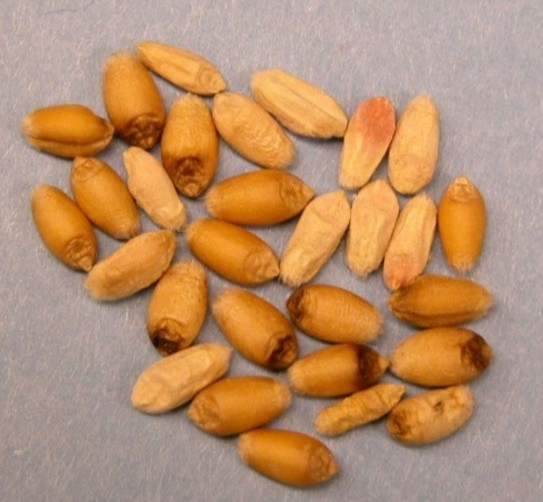
Image 1. Scabby and Tombstone Kernels
If growers absolutely need to plant saved seed due to availability or other economic considerations, the following steps should be taken to increase the likelihood of establishing a legal and good wheat crop:
Step One: Determine if you can legally plant the wheat seed you saved. Today, many private wheat varieties now come with statements which buyers sign at the time of purchase, stating that they understand they are not authorized to use the harvested grain for seed. Most current public winter wheat varieties are Plant Variety Protected (PVP) and though you may replant them on your own land, you do not have the right to trade/sell seed of those varieties to others for planting.
Step Two: Once you have determined if you can legally plant the seed you saved, the next step is to clean the wheat seed. It is important that wheat seed be cleaned to remove small and damaged seeds and to eliminate weed seeds. Removing small and damaged seeds will not only aid in crop establishment but will also provide a more uniform wheat seedling stand. Removing small and damaged seeds will also increase the thousand-kernel weight (TKW), which serves as a measure of seed quality. Wheat seed with TKW values greater than 30 grams tend to have increased fall tiller number and seedling vigor.
Step Three: Perform a germination test. Germination tests can either be completed at home or by sending a sample to the Wisconsin Crop Improvement Association. A home test can be performed by counting out 4 sets of 100 seeds and placing each of them in a damp paper towel. Place the paper towel into a plastic bag to conserve moisture and store in a warm location out of direct sunlight. After five days, count the number of germinated seeds that have both an intact root and shoot. This will give the grower an estimate of % germination. It is important to choose random seeds throughout the entire seed lot and conduct at least 4 – 100 seed counts. If germination is below 85%, consider increasing the seeding rate to compensate; however, we would caution growers from seeding any wheat with a germination test below 80%.
Step Four: Assess the need for seed treatment. A number of fungicides and insecticides are labeled for use as seed treatments on winter wheat and are listed in What’s on Your Seed Tool. Seed treatment fungicides protect germinating seed and young seedlings from seedborne and soilborne pathogens. Seed treatment fungicides will not improve germination of seed that has been injured by environmental factors and will not resurrect dead seed. If seed with scab must be used for planting, a seed treatment fungicide is a must to improve germination and protect stand. Note that planting scabby seed won’t increase the risk of FHB next spring. Also remember that seed treatment fungicides applied this fall will not protect against potential FHB infection next summer. You may still need to apply a foliar fungicide during anthesis to control FHB.
Seeding Depth
Wheat should be planted at least 1.0 inch deep depending upon soil moisture conditions. Wheat planted less than 0.5 inches deep may result in uneven germination due to seed exposure or dry soil conditions. Shallow planted wheat is also more susceptible to winterkill. Wheat planted more than 1.5 inches deep may result in death due to pre-mature leaf opening or poor tiller development and winter survival. Uniform seed placement and seeding depth are important in promoting crop health in the fall.
Seeding rate
The targeted fall stand for wheat planted from September 15th to October 1st is 40 plants per square foot. This is about 25 plants per foot of row in 7.5” rows. To achieve this goal, the seeding rate for soft red winter wheat is 1,750,000 viable seeds per acre (Table 1).
Table 1. Recommended winter wheat seeding rate by planting date.
| Seeds/acre (million) | Seeds/ft.2 | Row width (in.) | ||
| 6 | 7 | 7.5 | ||
| Seeds foot-1 of row | ||||
| 1.50 | 34.4 | 17.2 | 20.1 | 21.5 |
| 1.55 | 35.6 | 17.8 | 20.8 | 22.2 |
| 1.60 | 36.7 | 18.4 | 21.4 | 23.0 |
| 1.65 | 37.9 | 18.9 | 22.1 | 23.7 |
| 1.70 | 39.0 | 19.5 | 22.8 | 24.4 |
| 1.75 | 40.2 | 20.1 | 23.4 | 25.1 |
| Recommended seeding rate prior to Oct. 1 | ||||
| 1.80 | 41.3 | 20.7 | 24.1 | 25.8 |
| 1.85 | 42.5 | 21.2 | 24.8 | 26.5 |
| 1.90 | 43.6 | 21.8 | 25.4 | 27.3 |
| 1.95 | 44.8 | 22.4 | 26.1 | 28.0 |
| 2.00 | 45.9 | 23.0 | 26.8 | 28.7 |
| Recommended seeding rate Oct.1 to Oct.10 | ||||
| 2.05 | 47.1 | 23.5 | 27.5 | 29.4 |
| 2.10 | 48.2 | 24.1 | 28.1 | 30.1 |
| 2.15 | 49.4 | 24.7 | 28.8 | 30.8 |
| 2.20 | 50.5 | 25.3 | 29.5 | 31.6 |
| 2.25 | 51.7 | 25.8 | 30.1 | 32.3 |
| Recommended seeding rate after Oct.10 | ||||
| 2.30 | 52.8 | 26.4 | 30.8 | 33.0 |
| 2.35 | 53.9 | 27.0 | 31.5 | 33.7 |
| 2.40 | 55.1 | 27.5 | 32.1 | 34.4 |
| 2.45 | 56.2 | 28.1 | 32.8 | 35.2 |
| 2.50 | 57.4 | 28.7 | 33.5 | 35.9 |
Depending upon varietal seed size, this equates to 100 to 175 pounds of seed per acre (Table 2).
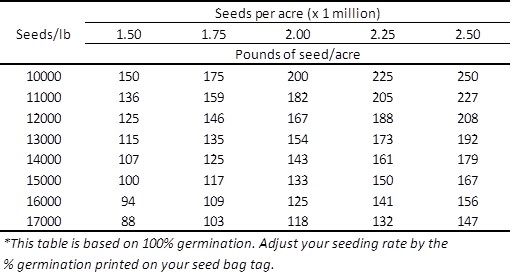
Table 2. Seed size and seeding rate conversion table.
Our data from the 2024/5 growing seasons indicate a significant yield increase when increasing your seeding rate from 0.75 and 2.25 million seeds per acre; however, that marginal yield increase was likely offset by the increased seed cost over 1.5 million seeds (Figure 1). The optimal seeding rate for wheat planted after October 1st should be incrementally increased as planting date is delayed compensating for reduced fall tillering (Table 1).
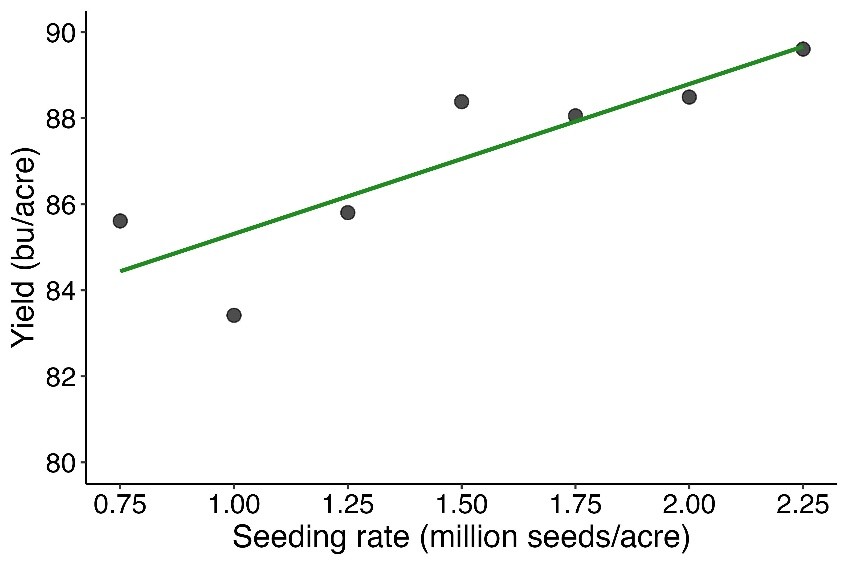
Figure 1. Winter wheat grain yield response to increasing seeding rates across four locations in Wisconsin (2025).
Planting Date
Winter wheat in WI should be seeded between September 20th and October 10th. Figure 2 shows yield and test weight response to planting date at Arlington, WI. Yield losses of 0.94 bu/a/day are possible with delayed planting after Sept. 25. Test weight response was significant but minimal.
Planting wheat too early can lead to increased incidence of barley yellow dwarf virus (BYDV) due to feeding and virus transmission by aphids. Many species of aphids (as many as 20) can transmit BYDV to wheat in the fall. Considering that there were higher levels of BYDV observed in recent years (2025 included), it is imperative to wait until after September 20th to be sure aphid activity is minimal. Aphid ability to feed on wheat and transmit BYDV is limited when temperatures are cooler. Waiting to plant wheat until later September shortens the potential aphid feeding time. Planting too early can also lead to excessive fall growth and potential smothering (increased winter respiration and winterkill) of the crop. There are also increased risks of planting too late. If air and soil temperatures get too cold, wheat will not germinate and emerge timely.
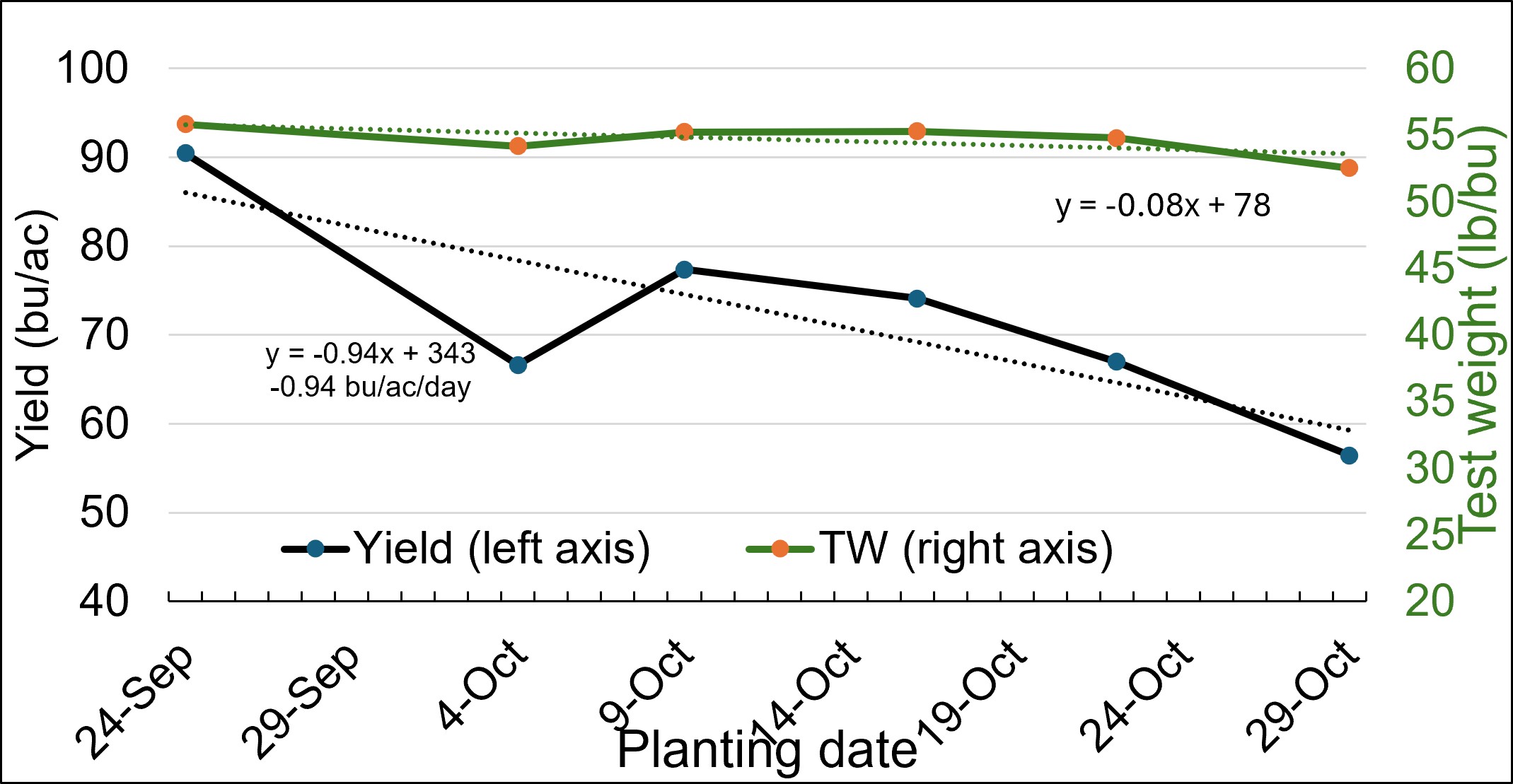
Figure 2. Winter wheat grain yield and test weight response to planting date at Arlington WI in the 2019 and 2020 growing seasons.
Winter wheat and crop insurance (Information courtesy of Michelle Austin, Director of Insurance Operations; and Mindy Tracy, Insurance Officer; Compeer Financial)
Winter wheat and crop insurance (Information courtesy of Michelle Austin, Director of Insurance Operations; and Mindy Tracy, Insurance Officer; Compeer Financial) The Wisconsin winter wheat final planting date varies by county, ranging from October 10th to October 15th. If the wheat is seeded after the county’s final plant date (late planting period) the crop insurance guarantee is reduced by 1% per day until the end of the late plant period that varies by county. If wheat is seeded after the late planting period, the crop insurance guarantee is reduced to 60% of the original guarantee or made uninsurable.
Special notes regarding the 2027 crop. The most notable changes are that ECO and SCO coverage levels for 2027 have been modified. SCO insurance now covers from MPCI coverage level up to 90%. ECO insurance now only offers one coverage level of 90-95%. Prior to 2027, ECO had two coverage level options and SCO coverage stopped at 86%. SCO continues to no longer require PLC as an FSA program requirement. A producer can now have either PLC or ARC and participate in SCO. Talk to your crop insurance agent for more details.
Additionally:
- Winter wheat coverage is not available in all Wisconsin counties.
- Air seeded (flown on by airplane) wheat is not insurable and no premium is charged.
- The final day to turn in a 2026 winter wheat claim is October 31st.
- The 2027 wheat price discovery on CBOT (using September ’26 contract) will be determined as follows (this price will be used for both yield protection and revenue protection plans of insurance).
- The Projected Price tracks from August 15, 2026 – September 14, 2026
- The Harvest Price tracks from August 1, 2027 – August 31, 2027
- There is a 200% maximum difference between the Base and Harvest Prices with no downside limit.
- Coverage levels range from 50%-85%.
Crop Rotation
Yield data from our long-term rotation experiment located at Arlington, WI indicated that wheat grain yield was greatest when following soybean (Table 5) (Marburger, D., S.P. Conley, P.D. Esker, J.G. Lauer, and J.M. Ané. 2015. Yield Response to Crop/Genotype Rotations and Fungicide Use to Manage Fusarium-Related Diseases. Crop Sci. 55:1-10. doi: 10.2135/cropsci2014.03.0201). Our data suggests that growers should plant wheat after soybean first, then corn silage, corn for grain, and lastly wheat.
Table 5. Winter wheat grain yield following winter wheat, soybean, corn for grain, and corn silage.
| Rotation | 2010 | 2011 | 2012 | Average |
| Continuous Wheat | –1 | –1 | 38.5 | 38.5 |
| Corn-Soybean-Wheat | 66.9 | 89.9 | 94.4 | 83.7 |
| Soybean-Corn(grain)-Wheat | 57.8 | 59.0 | 81.6 | 66.1 |
| Soybean-Corn(silage)-Wheat | 72.9 | 80.5 | 81.5 | 78.3 |
| 1Not able to collect data due to extremely low yields | ||||
If growers choose to plant second year wheat, several management factors should be considered to reduce risk. First plant a different wheat variety in the second year that possesses excellent resistance to residue-borne diseases. Under no circumstances should growers consider planting bin-run seed in second year wheat. By planting a different variety with strong disease resistance characteristics, you can reduce the likelihood of early disease pressure and significant yield loss. Growers should use a seed treatment in wheat following wheat. Be aware that seed treatments are not a cure for all common diseases in continuous wheat systems (e.g., take-all, Cephalosporium stripe). Growers should also consider increasing their seeding rate to 1.8 to 2.0 million seeds per acre in wheat following wheat systems. This will aid in stand establishment and increase the likelihood of a uniform stand going into the winter. Lastly, if using a no-till system, planting into a seedbed that is free of living volunteer wheat is important in reducing the incidence of BYDV. Growers should consider an herbicide application to destroy any living volunteer wheat at least 2 weeks prior to planting to prevent a “green bridge” for the aphids that transmit BYDV.