Damon L. Smith Extension Field Crops Pathologist Department of Plant Pathology, University of Wisconsin–Madison
As we move deeper into the growing season, two diseases are back on the radar across Wisconsin and the broader Midwest: tar spot in corn and white mold in soybean. While current pressure is low, both diseases are heavily influenced by weather and crop growth stage, meaning preparation and timely decision-making are key.
Here’s what you need to know right now.
Tar Spot: Present, but Not Yet a Panic
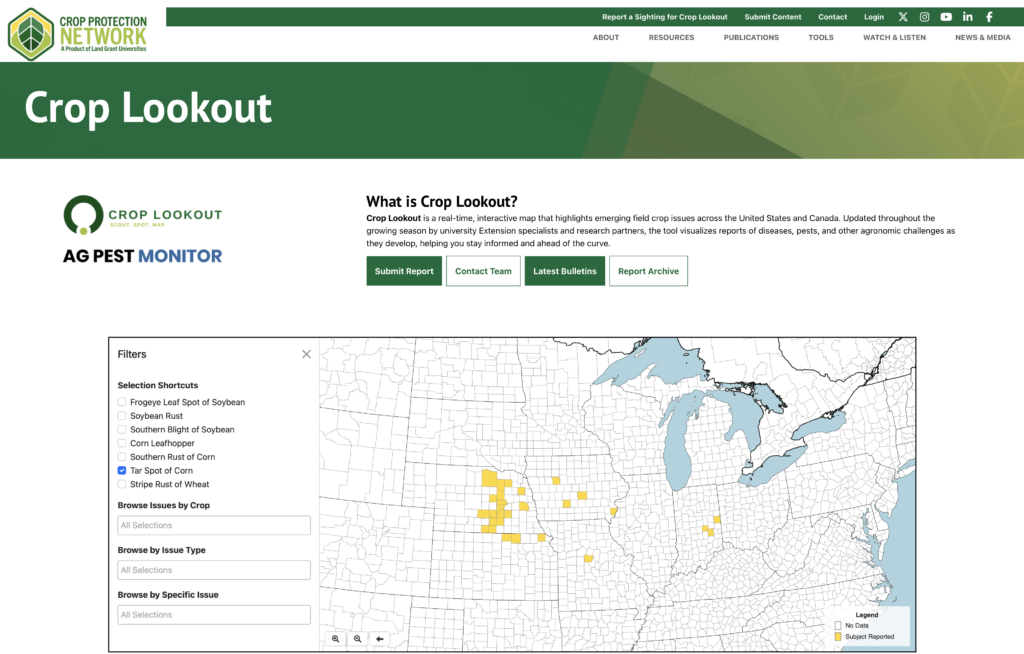
Tar spot has now been confirmed across several Midwestern states to the south of Wisconsin (Fig. 1). This is very early to find tar spot in the Midwest. The good news is that severity and incidence remain very low, and fungicide applications are not warranted at this time.
However, tar spot is firmly established in the region, so the focus should be on preparedness rather than reaction.
Know Your Risk
The first step is understanding whether tar spot has occurred in your fields before. If it has, assume the pathogen is present locally. Disease risk then depends on the classic “disease triangle”—host, pathogen, and weather.
For tar spot, weather drives risk, especially:
- Intermittent wet/dry cycles
- Leaf wetness (especially overnight)
- High humidity and dew points
- Moderate temperatures
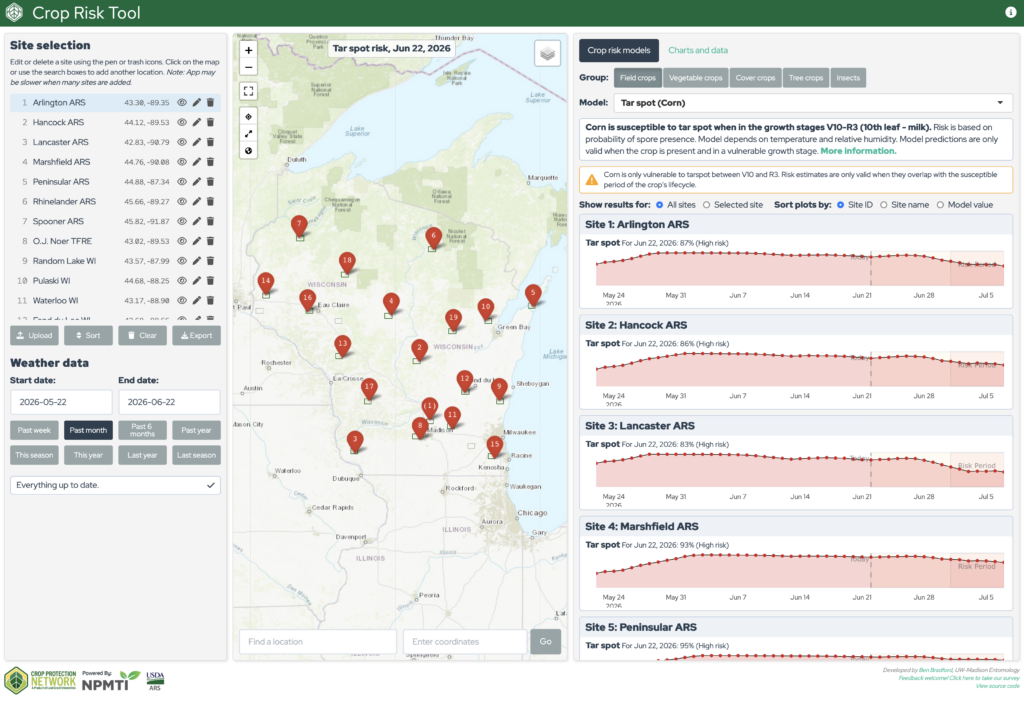
The Crop Protection Network Crop Risk Tool and the Wisconsin Agricultural Forecasting System are decision support tools that can be used to help assess whether conditions have been favorable for disease development. These tools don’t detect the pathogen, but they do help determine whether the environment is conducive. Currently the risk for tar spot development is very high across the entire state of Wisconsin (Fig. 2).
Should You Spray at V8–V10?
Short answer: No.
At this stage, tar spot—if present—is typically confined to lower canopy leaves and at low severity, posing little risk to yield. Yield loss generally isn’t observed until severity reaches about 10% on the ear leaf or above.
Instead:
- Scout fields regularly
- Focus on susceptible hybrids
- Monitor disease progression in lower leaves
- Watch the risk models
Timing Fungicide Applications
If conditions become favorable and disease severity increases, fungicide timing becomes critical.
Key recommendations:
- Avoid applications before V10 in most situations
- Target a single, well-timed spray between VT and R3
- Use products with multiple modes of action (QoI + DMI ± SDHI) for better efficacy and resistance management
Bottom line: stay ready, but don’t rush applications too early.
White Mold: Watch the Weather During Bloom
While 2025 saw spotty white mold in soybeans, the 2026 season has been mostly cool and now wet, which are favorable for white mold development.
As soybeans enter the flowering period, attention to weather becomes critical.
Understanding Infection Risk
White mold infects soybean plants through open and senescing flowers, with spores produced by small mushroom-like structures called apothecia.
Risk of infection increases when:
- Weather is cool and moist
- Bloom is prolonged
- Canopies are dense
Cool conditions can create a “double whammy” by promoting fungal development while simultaneously slowing crop growth and extending flowering, increasing infection risk.
Using Prediction Tools
Again, the Crop Protection Network Crop Risk Tool and the Wisconsin Agricultural Forecasting System are decision support tools that can help manage the complexity of determining the risk of infection by the white mold fungus. These models use the following weather variables when the crop canopy has closed to calculate risk:
- Temperature
- Relative humidity
- Wind speed
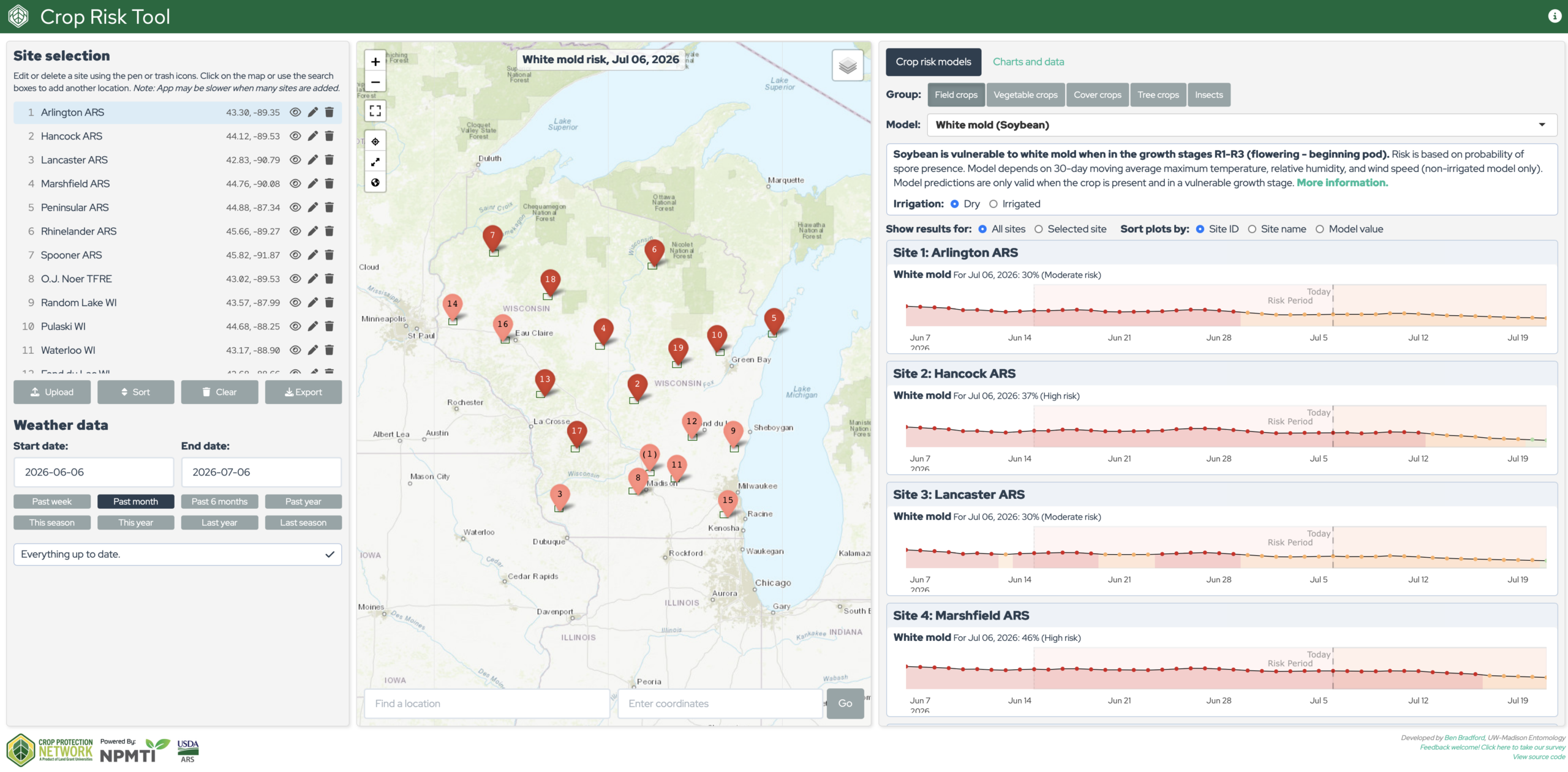
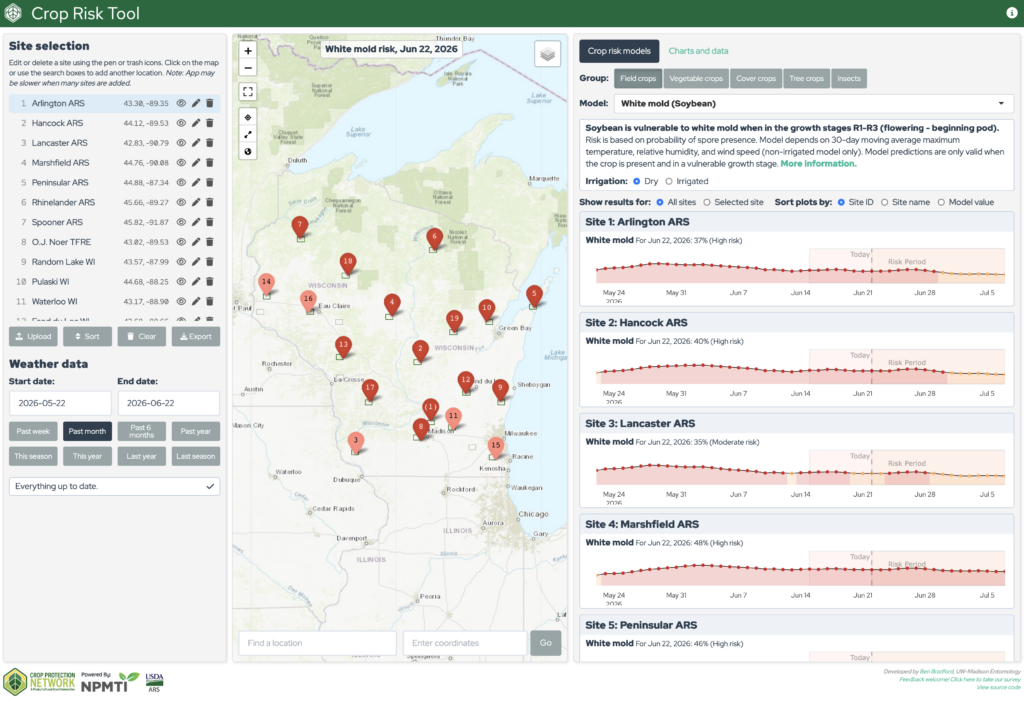
Currently the white mold risk across Wisconsin is moderate to high (Fig. 3). This means that if the canopy has closed and flowers are present, the risk for infection is high. Fortunately, much of the soybean crop isn’t there yet, but we need to be ready.
When to Spray for White Mold
The flowering period (R1–R3) is the critical window for fungicide application.
Key points:
- Best results often occur when applications are made closer to R3 rather than early R1
- Ensure good canopy penetration (higher water volume, slower speeds, adequate pressure)
- Consider products like Endura, Omega, or Cobra based on field history and conditions
For fields planted with highly susceptible varieties, it may be necessary to act at lower risk thresholds than forecast in the risk tools. For example, a highly susceptible variety might need to be sprayed when risk is considered moderate. What the 7-14 day trends too, if they are rising risk is there for infection.
The Big Picture: Scout, Monitor, Prepare
Both tar spot and white mold are weather-driven diseases that reward proactive management.
Across both crops, the same principles apply:
- Use forecasting tools to understand risk
- Scout fields frequently and deliberately
- Know your field history and hybrid/variety susceptibility
- Time fungicide applications carefully for maximum return
The Fungicide product decision can also be complicated for both diseases. Fortunately, we have sorted through large amounts of fungicide test data from all across the U.S. and developed economic models that have been turned into interactive calculators. These can be found at the Crop Protection Network and were updated in early 2026. Use these ROI Calculators to run various scenarios that might fit your farm to determine which products might provide the best return on investment for both of these diseases.
The Take-Home Message
- Tar spot: Present but low—hold off on spraying and continue scouting
- White mold: Risk increasing—watch weather and crop stage closely
- Both tar spot and white mold: Preparation and timing are far more important than reacting too early
Above all—don’t panic, but don’t ignore the signals. Stay informed, stay flexible, and be ready to act when conditions warrant.
Other Resources
- To find more information on tar spot, view a web book from the Crop Protection Network, CLICK HERE.
- Wisconsin Fungicide Research Test Studies, CLICK HERE.
- To watch an in-depth video on white mold management, CLICK HERE.
- To find more information on white mold, view a web book from the Crop Protection Network, CLICK HERE.