Damon L. Smith, Extension Field Crops Pathologist, Department of Plant Pathology, University of Wisconsin-Madison
Life as a field crops pathologist in Wisconsin has been reasonably quiet so far this season. April was one of the wettest on record, while May was one of the driest on record. Given the recent dry spell, diseases have been of little concern on corn and soybeans. Timely rains in June might change this situation, so folks should remain diligent in scouting and making informed decisions about in-season management.
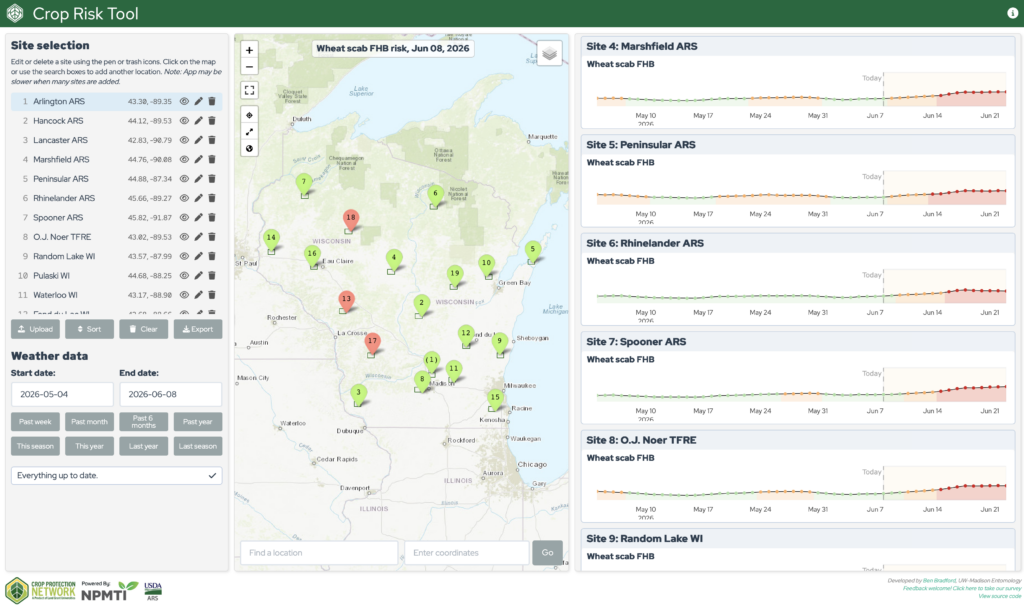
In winter wheat, we have been watching the Fusarium head blight (FHB; scab) situation carefully. Wheat in the southern portion of the state has likely already gone through anthesis. This means the window of opportunity to apply a fungicide for FHB management has passed. However for farmers in central and northern Wisconsin, that window is open or quickly approaching. The current FHB forecast (Fig. 1) is showing that much of the state is currently at low risk for FHB on susceptible varieties. However, looking at the two-week forecast for central and northern locations shows predictions of moderate to high risk for FHB. Farmers and consultants should watch these forecasts carefully. Remember the time to apply a fungicide for FHB management would be from the start of anthesis to about 5 days after the start of anthesis. If risk is high during that period for a particular crop, the likelihood a fungicide will produce positive ROI is high.
While we do have one confirmed report of stripe rust in Wisconsin, there have been no other confirmations. Fortunately, all of the fungicides used for FHB management also provide excellent stripe rust management. Thus, we should be able to “kill two birds with one stone” with a timely FHB fungicide application if needed. I think hot and dry weather going into June has kept stripe rust in check. Again, this situation can change quickly if it turns wet and cooler. So be sure to pay attention and scout, scout, scout!
So what should you do?
- Continue to scout for stripe rust. Know what you are trying to manage in winter wheat!
- Plan to apply an FHB fungicide application if you are not yet at anthesis – especially on susceptible varieties
- Shoot for Anthesis or up to 5-days after the start of anthesis for the fungicides rated “G” for FHB in this table.
- All of the available fungicides rated for FHB are also effective against stripe rust. Thus, one fungicide can manage both problems!
- Continue to what the CPN Risk Tool above or the “Scab Alerts” – it isn’t perfect but can help you plan (http://www.wheatscab.psu.edu).