Damon L. Smith, Extension Field Crops Pathologist, Department of Plant Pathology, University of Wisconsin–Madison
As we move deeper into the growing season, fungicide application decisions become one of the biggest sources of stress for farmers across the Midwest. Between aggressive marketing, endless online opinions, and an expanding list of fungicide products, determining whether, and when, to spray can feel overwhelming.
Add tight farm margins to the equation, and every decision carries significant financial implications. The possibility of spending money on a fungicide application that may not pay off can make the decision particularly difficult.
Traditionally, many fungicide applications have been made based on the calendar or crop growth stage. While these approaches can sometimes result in a positive return on investment (ROI), they are far from perfect. Disease development depends on much more than the crop’s growth stage. Successful disease outbreaks occur only when the components of the disease triangle come together: a susceptible host, a virulent pathogen, and favorable environmental conditions.
As a result, calendar-based applications can lead to fungicides being applied when disease risk is low or when timing is not aligned with pathogen infection. Fortunately, advances in plant pathology and epidemiology have led to the development of disease forecasting tools that help improve decision-making and increase the likelihood of an economic return from fungicide applications.
Using Data to Improve Decisions
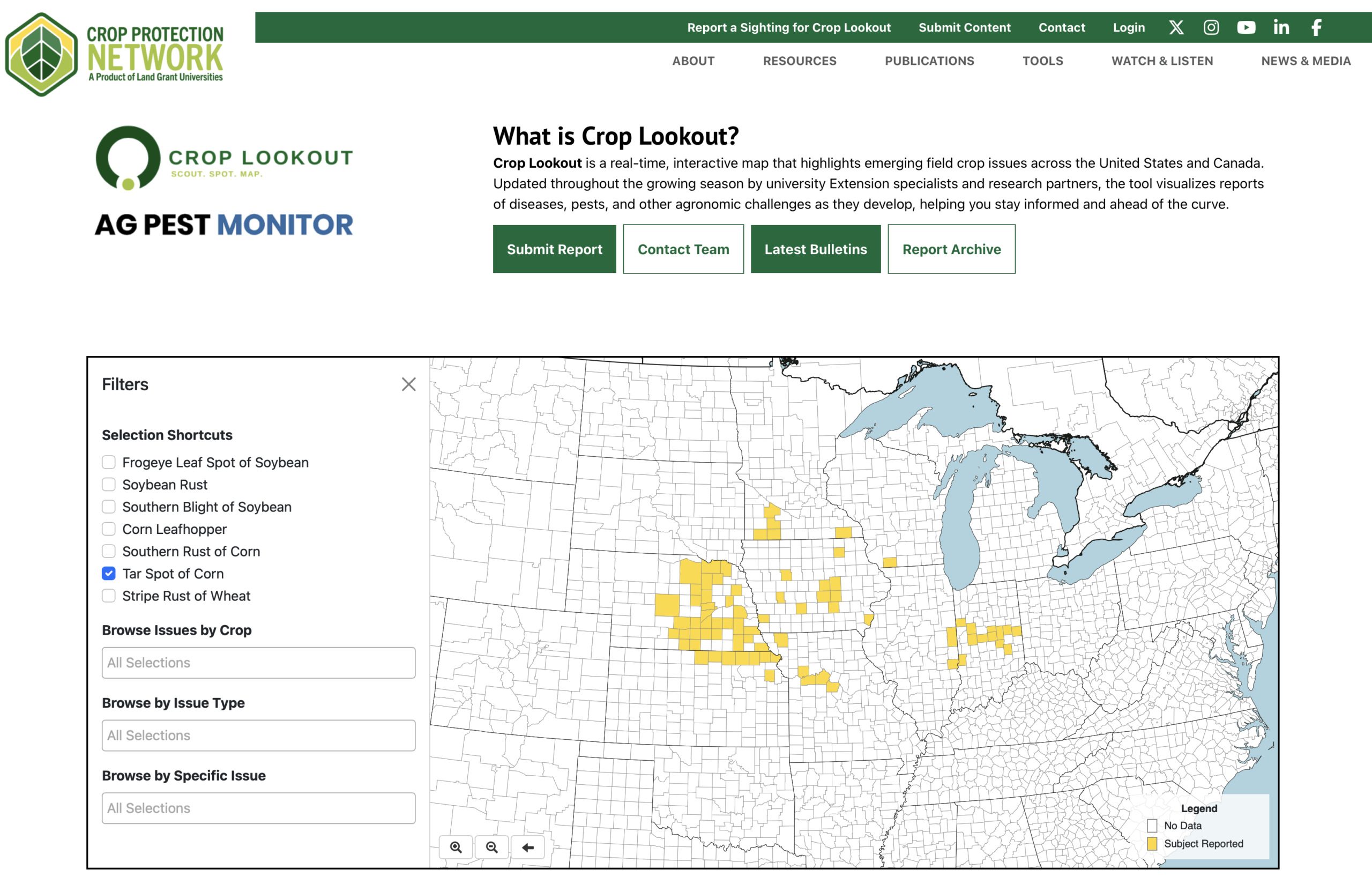
One of the most useful resources available today is the Crop Protection Network (CPN) Crop Risk Tool (Figure 1). This free, publicly available tool uses grid-based weather data along with mathematical and machine-learning models to estimate disease risk for specific field locations.
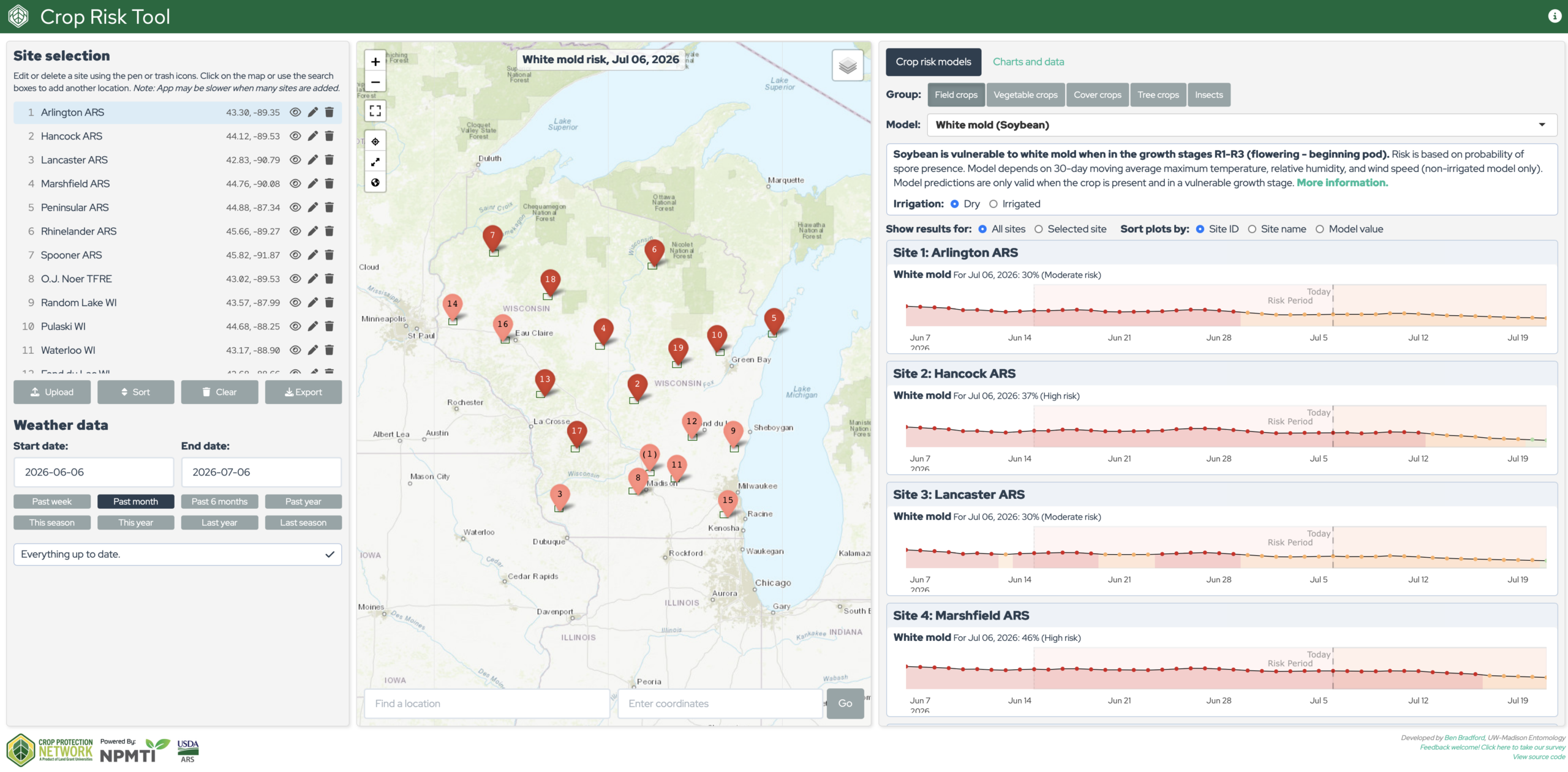
By combining weather conditions with our understanding of crop and pathogen biology, the tool provides farmers with a science-based assessment of disease risk. Depending on the disease, that information can then be used to guide scouting activities or fungicide application decisions.
Not All Diseases Should Be Managed the Same Way
A common mistake is assuming that disease forecasting tools should be used identically for every disease. How you use a risk prediction tool depends heavily on the biology of the pathogen. Let’s explore these different cases.
White Mold of Soybean: Using the Tool as a Crystal Ball
White mold, caused by Sclerotinia sclerotiorum, is what plant pathologists refer to as a monocyclic disease, meaning it generally has only one major infection cycle during the growing season.
Because infection opportunities are limited, disease risk predictions must be used proactively. In this case, the Crop Risk Tool essentially allows you to look into the future and estimate the likelihood of disease development later in the season.
If soybean fields are flowering, canopy closure between rows exceeds approximately 40%, and the risk tool indicates elevated risk, then a field with a history of white mold is likely at substantial risk for disease development. In this situation, the forecasting tool can directly support a fungicide application decision, because the window for preventive action is relatively narrow.
Tar Spot of Corn: Using the Tool to Guide Scouting
Tar spot, caused by Phyllachora maydis, behaves very differently. Unlike white mold, tar spot is a polycyclic disease, meaning the pathogen can complete multiple infection cycles in a single season.
This distinction is important. Since disease pressure can build over time, farmers have more opportunities to gather information before deciding whether a fungicide application is warranted.
For tar spot, the Crop Risk Tool is often most valuable as a scouting aid rather than a stand-alone spray decision tool. If disease risk is elevated and the crop is approaching tasseling, that should trigger increased scouting efforts to determine whether the disease is present and active in the field.
Unlike white mold, where risk forecasting is often predictive, tar spot management benefits from combining forecast information with direct field observations before making a fungicide decision.
Timing Matters for Fungicide ROI
Regardless of the disease, proper timing is one of the most important factors influencing fungicide ROI. However, the optimal application window varies by disease and pathogen biology.
Understanding whether a disease is monocyclic or polycyclic can help determine how forecasting information should be used. In some situations, the forecasting tool functions as a predictive decision aid that helps anticipate future disease risk. In others, it serves as a scouting tool that helps identify fields requiring closer observation.
Working with a knowledgeable crop advisor or investing time in understanding the major diseases affecting your crops can significantly improve decision quality and increase the chances of a profitable fungicide investment.
Avoid Unnecessary Fungicide Applications
The Crop Protection Network also offers additional resources, including ROI calculators that can help evaluate the economic value of fungicide applications.
These tools are particularly useful when combined with disease risk forecasts to support data-driven management decisions.
Most importantly, farmers should avoid making fungicide applications solely because the calendar suggests it is time to spray. Unnecessary applications not only increase production costs but also contribute to fungicide resistance development in pathogen populations.
With relatively few fungicide modes of action available for field crops, preserving these tools is essential. Avoiding even a single unnecessary application can help extend the useful life of important fungicide products and improve long-term disease management sustainability.
Key Take-Home Messages
- Disease forecasting tools help reduce uncertainty and improve fungicide decision-making.
- Calendar-based or growth-stage-only applications often miss critical information about disease risk.
- The Crop Protection Network Crop Risk Tool uses weather data and disease models to provide science-based risk assessments.
- Disease biology matters. Different diseases require different approaches to risk interpretation.
- White mold is a monocyclic disease, making forecasting tools valuable for anticipating infection risk and guiding preventive fungicide applications.
- Tar spot is a polycyclic disease, making forecasting tools especially useful for prioritizing scouting efforts before making spray decisions.
- Combining risk forecasts with field observations often leads to better fungicide decisions and improved ROI.
- Proper application timing is one of the most important factors affecting fungicide performance and profitability.
- Fungicide ROI calculators can complement disease forecasting tools when evaluating treatment decisions.
- Avoiding unnecessary fungicide applications saves money and helps slow the development of fungicide resistance.
- Preserving fungicide efficacy today helps maintain management options for future growing seasons.
Disease forecasting tools are not a replacement for agronomic expertise or field scouting, but when used correctly, they can help farmers make more confident, economically sound, and sustainable in-season disease management decisions.