Paul D. Esker, Tatiane Severo Silva, Damon L. Smith, and Shawn P. Conley
Adapted from: Paul D. Esker, Denis A. Shah, Spyridon Mourtzinis, Patricio Grassini, Tatiane Severo Silva and Shawn P. Conley. 2026. Marginal causal effect of fungicide seed treatments on soybean yield and uncertain profitability in the US Midwest. Scientific Reports. https://doi.org/10.1038/s41598-026-47390-0
In a bean pod:
- The best rainfed randomized controlled trial (RCT) data show an average fungicide seed treatment (FST) yield benefit of roughly 0.33 bu/acre — statistically marginal and unlikely to cover costs in most price environments.
- Economic simulations show mean net losses across most cost and price combinations; positive returns require both low FST costs and near-record soybean prices.
- Blanket FST use as universal insurance is not supported by the causal evidence under typical rainfed Midwest conditions.
- A targeted approach — FSTs where risk factors are documented, confirmed by on-farm strip trials, is more consistent with the evidence.
- Recommendations backed only by irrigated or artificially inoculated trial data likely overstate real-world benefit and deserve scrutiny.
Why This Study Matters
Fungicide seed treatments (FSTs) are now near-universal on Midwest soybean farms. Adoption climbed from 8% of acres in 1996 to 30% by 2008 and reached 60–75% by 2015. Yet whether FSTs actually pay under typical rainfed commercial conditions has rarely been examined with rigorous methods. Most published trial data come from settings that do not reflect commercial farms — irrigated plots,
artificially inoculated disease pressure, or fields selected for high disease risk. Those results likely overstate real-world benefit. Meanwhile, an estimated 579 short tons (525 metric tons) of seed-applied fungicide was used on northern U.S. soybeans from 2006 to 2014, raising legitimate questions about cost-effectiveness. This study used both randomized controlled trial (RCT) data and a large on-farm observational dataset to estimate the causal yield benefit of FSTs under commercial rainfed conditions and translate it into net dollars using realistic inputs.
What Researchers Wanted to Find Out
- What is the average causal effect of FSTs on soybean yield under non-irrigated, commercial-scale Midwest conditions?
- Do certain fields or environments benefit more than others, and if so, what factors predict a larger response?
- Under realistic cost and price scenarios, are FSTs economically profitable?
Key Findings
Average yield benefit is real but small
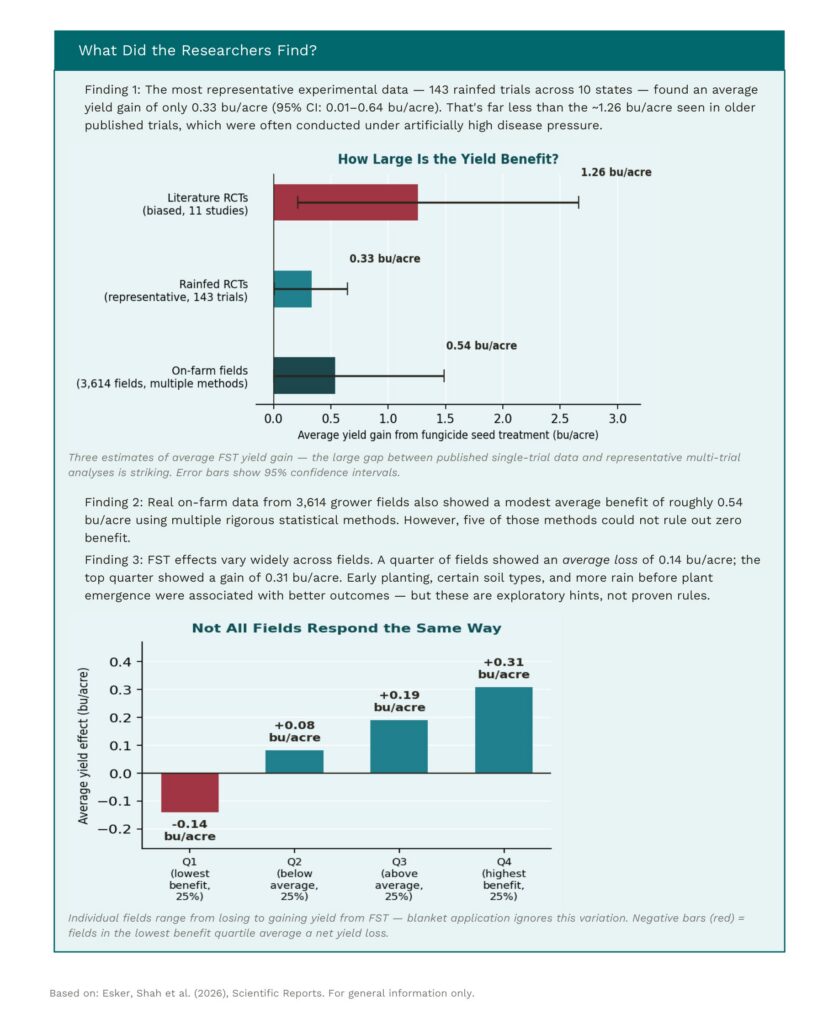
The curated rainfed RCT database — the least-biased experimental estimate — found an average treatment effect (ATE) of 0.33 bu/acre (95% CI: 0.01–0.64 bu/acre). A causal analysis of soybean production data supplied by growers themselves gave a consensus ATE of approximately 0.54 bu/acre, but all five estimation methods had confidence intervals that included zero. The literature-based estimate of 1.26 bu/acre is largely drawn from irrigated and artificially inoculated trials. It is important to account for these environmental differences when applying these estimates to standard rainfed commercial fields.
Most fields show no statistically reliable benefit
With confidence intervals spanning zero in both analyses, the average effect across typical Midwest fields is too small and variable to be reliably detected in most situations. FSTs can work, but benefit cannot be assumed for any given farm or year.
Economic returns are uncertain and often negative
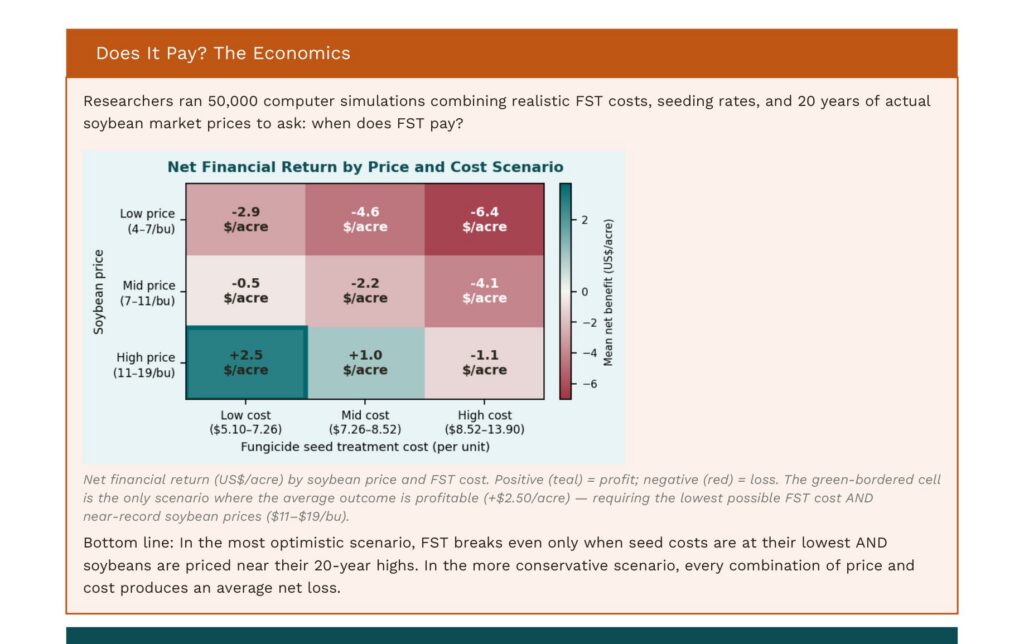
Net benefit exceeded $2/acre only when FST costs were at the low end ($5.10–$7.26/unit) and soybean prices were near 20-year highs ($11–$19/bu); even then the mean net benefit was just +$2.50/acre. Under a more conservative yield-response scenario, achieving a break-even point proved challenging across most cost-by-price combinations, with models projecting net returns ranging from -$5.89 to -$10.18/acre.
Some fields may benefit more — but findings are exploratory
The highest-response quartile of fields showed an estimated average effect of +0.31 bu/acre; the lowest quartile showed −0.14 bu/acre, with a confidence interval entirely below zero. Early planting dates, soil pH around 6.6–6.7, and higher pre-emergence precipitation were associated with greater expected benefit. These are exploratory patterns to be tested, not confirmed prescriptive triggers.
 Estimated effect is moderately robust to hidden confounders
Sensitivity analysis showed that an unmeasured variable would need to be at least as strongly associated with both FST use and yield as the strongest measured covariate to explain away the estimated effect, a moderately high bar that provides some confidence in the direction of the finding.
What This Means for Soybean Production and Advising
The evidence does not support FSTs as a blanket practice on every Midwest soybean acre. The average causal yield benefit under rainfed conditions is small, statistical uncertainty is high, and economic modeling shows negative or negligible net returns except under a narrow set of favorable conditions. What is supported is a targeted, IPM-based approach: apply FSTs where risk factors are documented and verify returns through on-farm strip trials. While adoption of FSTs has reached 60-75%, our data suggests this high adoption rate does not necessarily correlate with a positive return on investment under rainfed conditions.
What to Do with This Information
- Do not assume FSTs pay on every field. The average causal yield benefit under rainfed conditions is roughly 0.33 bu/acre — too small to reliably cover costs except when prices are near 20-year highs and FST costs are low.
- Focus on documented risk factors. Early planting dates, fields with a history of seedling disease, or conditions associated with high disease pressure are the most defensible situations to treat. These are starting points for evaluation, not guaranteed triggers.
- Verify with on-farm strip trials. Replicated side-by-side comparisons over multiple seasons are the most reliable way to confirm whether FSTs pay under your specific conditions.
- Check whether cited trials were rainfed or irrigated, and whether disease pressure was natural or artificial. Irrigated and inoculated trials do not predict typical commercial performance.
- Consider cost and price together. Positive net returns require both low FST costs and near-record soybean prices. At average price levels, the economics rarely work out.
Acknowledgements: This work was supported by the Wisconsin Soybean Marketing Board, the North Central Soybean Research Program (Project 204331), the United Soybean Board (Project 24-210-S-A-1-A / 2411-210-0101), and by USDA National Institute of Food and Agriculture Hatch Appropriations to PDE (Project PEN04836 and Accession 7005075). Any findings, opinions or recommendations are those of the authors and do not necessarily reflect the views of the funding agencies.