Article by Guilherme Chudzik and Rodrigo Werle, UW-Madison Cropping Systems Weed Science Program
Giant ragweed and waterhemp are among the most troublesome weed species in Wisconsin corn–soybean production systems. The rapid evolution of herbicide resistance in these species is especially concerning, given the limited number of effective POST herbicide options available for their control.
One strategy to reduce resistance risk and prolong the effectiveness of foliar herbicides is to limit the number of weed plants exposed to them. Extensive research has shown that cover crops, including cereal rye, can help suppress weeds. However, the level of weed suppression depends on the amount of biomass produced, and this relationship has not been fully quantified. Therefore, determining how much cereal rye biomass is required to effectively suppress weeds is critical for successfully integrating this cover crop into weed management programs.
Research Overview
Between 2021 and 2023, field studies were conducted at sites naturally infested with either giant ragweed or waterhemp. Research took place at the Rock County Farm in Janesville, WI, and the O’Brien Family Farm near Brooklyn, WI. These efforts resulted in two site-years of data for giant ragweed (Chudzik et al. 2025) and five site-years for waterhemp (Nunes et al. 2024).
- Cereal rye was drilled in the fall at 60 lb ac⁻¹ at the UW–Madison Arlington Agricultural Research Station.
- In the spring, cereal rye was harvested at ground level at anthesis and oven-dried at 60 °C until constant mass.
- Eight biomass levels (ranging from 0 to 11,000 lb ac⁻¹) were evenly distributed across small plots and secured using wire fencing (Figure 1).
- At 42 days after study establishment, weed density and biomass were measured in each plot.
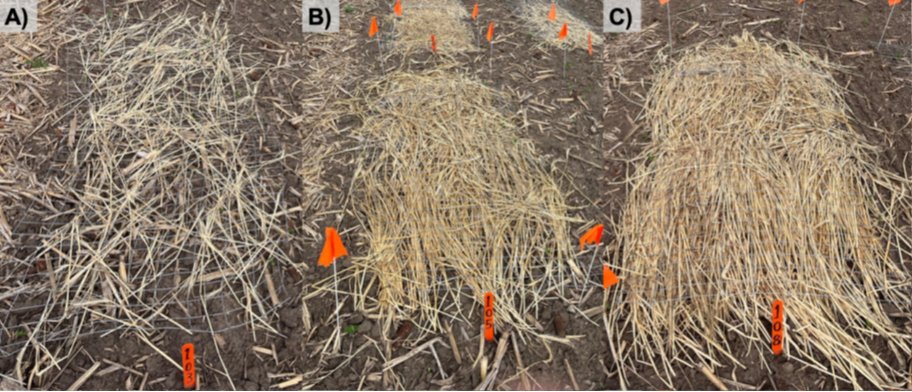
Figure 1. Overview of plots with dry cereal rye cover crop biomass levels of (A) 1,000 lb ac⁻¹, (B) 4,400 lb ac⁻¹, and (C) 11,000 lb ac⁻¹.
Research Findings
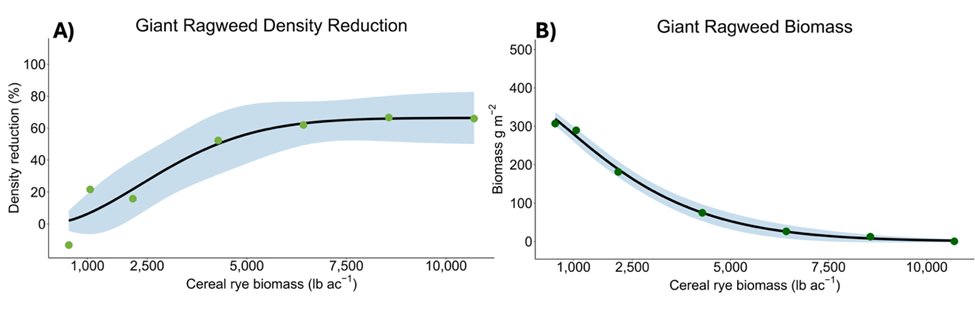
Figure 2. Regression curves from two site-years illustrating the effects of cereal rye cover crop biomass on: (A) giant ragweed density reduction and (B) giant ragweed biomass (Chudzik et al. 2025).
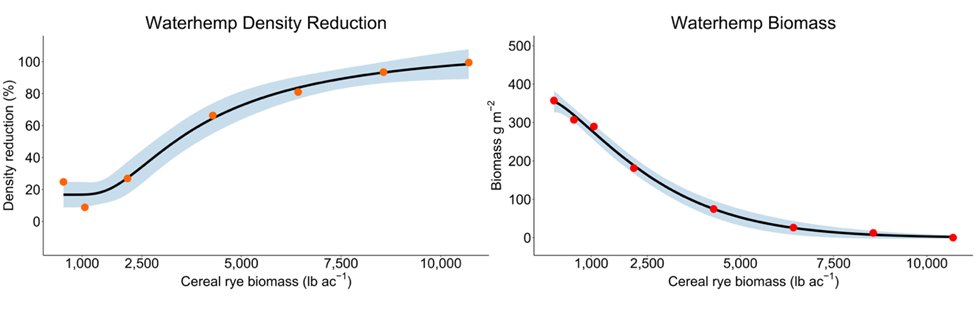
Figure 3. Regression curves from five site-years illustrating the effects of cereal rye cover crop biomass on: (A) waterhemp density reduction and (B) waterhemp biomass (Nunes et al. 2024).
All results showed a clear trend: as cereal rye biomass increased, weed pressure declined (Figures 2 and 3). Greater cereal rye biomass consistently reduced weed biomass, which is important because biomass is closely tied to plant growth, vigor, and seed production.
Weed density followed a similar pattern, but required higher levels of cereal rye biomass for meaningful reductions. In practical terms, growers aiming to slow weed growth and reduce vigor may achieve that goal with moderate cereal rye biomass. However, those seeking to reduce the number of emerged weeds, and therefore limit number of weeds exposed to POST herbicides, will need higher biomass levels. This distinction is critical for herbicide resistance management.
In short, more cereal rye biomass results in smaller and fewer weeds during the growing season, making in-season control more effective and lowering selection pressure for herbicide resistance.
Even at the highest biomass level evaluated (11,000 lb ac⁻¹), giant ragweed was not fully suppressed, with a maximum density reduction of 66%. In contrast, waterhemp was completely suppressed at this biomass level, with no plants emerging under the highest cereal rye biomass tested.
We also estimated ED₅₀ values, the cereal rye biomass required to achieve a 50% reduction in weed density or biomass (Table 1). These thresholds provide useful benchmarks for growers:
- Giant ragweed: Approximately 3,500 lb ac⁻¹ of cereal rye biomass reduced plant growth (biomass) by 50%, while about 4,250 lb ac⁻¹ was required to reduce seedling emergence (density) by 50% (Chudzik et al. 2024).
- Waterhemp: Around 2,500 lb ac⁻¹ reduced plant growth by 50%, whereas approximately 4,500 lb ac⁻¹ was needed to achieve a 50% reduction in plant density (Nunes et al. 2024).
Cereal rye height as a practical biomass indicator: Through multi-site collaborations supported by the Wisconsin Soybean Marketing Board and the United Soybean Board, we identified a strong relationship between cereal rye height and biomass. This finding suggests that growers can use plant height as a practical field indicator to assess whether biomass thresholds for weed suppression are being achieved (Table 1).
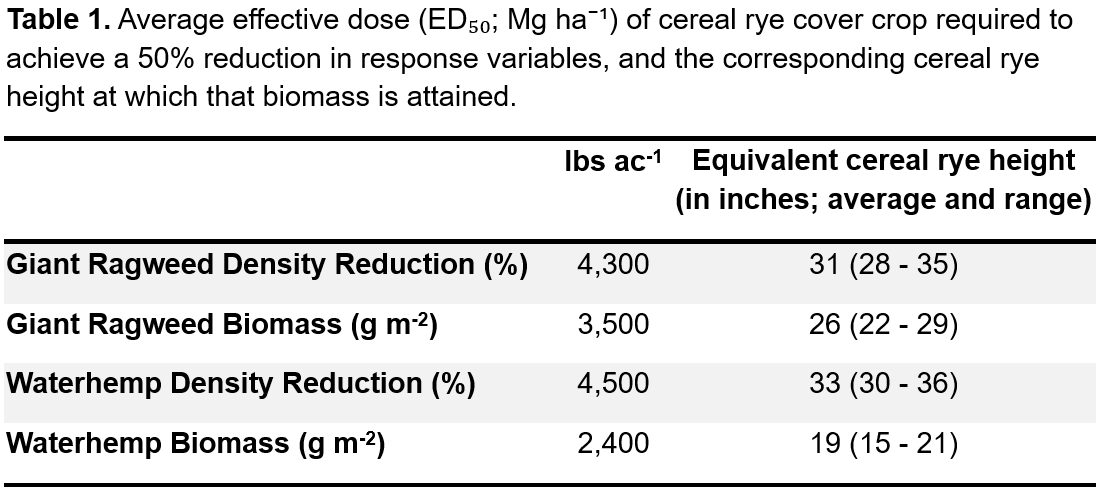
Our results indicate that when cereal rye reaches approximately 3 feet in height, it is a good time for termination, as this growth stage provides substantial suppression of both weed seedling emergence and early-season growth. While not the primary focus of this study, it is important to emphasize that soil-applied residual herbicides should still be included in high–cover crop biomass systems to ensure more consistent weed control.
Cereal rye is not a silver bullet and will not solve weed problems on its own. However, it can play an important role in reducing the number of weeds exposed to herbicides commonly used in corn–soybean rotations, thereby lowering the risk of herbicide resistance. Weed management is ultimately a numbers game, the fewer weeds to be sprayed, the lower the likelihood of selecting individuals with resistance traits.
What are the “don’ts” of cereal rye?
If spring conditions are dry, consider terminating cereal rye earlier. Actively growing cereal rye can use substantial soil moisture, potentially limiting water availability for the subsequent cash crop if termination is delayed.
High biomass systems are generally more compatible with soybean than corn. Although cereal rye can accumulate substantial biomass following soybean and ahead of corn, excessive biomass may increase early-season nutrient uptake and delay soil warming. Because corn is particularly sensitive to these conditions, this can reduce yield potential.
Additional Resources
For more information on this research, see the podcast episode from the Field, Lab, Earth podcast: https://fieldlabearth.libsyn.com/ or https://www.youtube.com/watch?v=K0MAY0TEw8c
A related UW-Madison Division of Extension article summarizing these findings is also available (Elmquist et al. 2026; Biomass Thresholds for Cereal Rye Cover Crop Goals): https://cropsandsoils.extension.wisc.edu/articles/biomass-thresholds-for-cereal-rye-cover-crop-goals/
References
Chudzik, G., Nunes, J. J., Arneson, N. J., Stoltenberg, D. E., & Werle, R. (2025). Cereal rye biomass effects on giant ragweed suppression inform management decisions. Agrosystems, Geosciences & Environment, 8(1), e70023. https://doi.org/10.1002/agg2.70023
Nunes, J. J., Arneson, N. J., Smith, D., Ruark, M., Conley, S., & Werle, R. (2024). Elucidating waterhemp (Amaranthus tuberculatus) suppression from cereal rye cover crop biomass. Weed Science, 72(3), 284-295. https://doi.org/10.1017/wsc.2024.21
The data presented in this article are derived from the MS research of Guilherme Chudzik and the PhD research of Jose Junior Nunes (@JoseJr_Nunes) at UW–Madison. The studies were sponsored by the Wisconsin Soybean Marketing Board.