Authored by: Ophelia Tsai and Shawn P. Conley
Soybean is unique among major grain crops because it can get much of its nitrogen from the atmosphere through biological nitrogen fixation, or BNF. This happens through a partnership between soybean roots and rhizobia bacteria. When this relationship is working well, soybean plants form nodules on their roots, and those nodules convert atmospheric nitrogen into a form the plant can use.
However, BNF does not happen at the same level in every field or every year. Soil nitrogen, weather, yield potential, crop growth, and stress conditions can all affect how much soybean relies on soil nitrogen compared with fixed nitrogen. That makes soybean nitrogen management a challenge, especially as growers continue pushing for higher yields.
In 2025, we planted a paired set of non-nodulating and nodulating soybean isolines from the University of Nebraska-Lincoln across 10 Wisconsin locations as part of a broader soybean bioinoculant trial. The larger trial was designed to evaluate whether Bradyrhizobium bioinoculants could increase soybean nodulation, BNF, and yield. For this article, however, we focused on the non-nodulating and nodulating isolines as a tool for understanding how much yield could be supported by soil nitrogen alone.
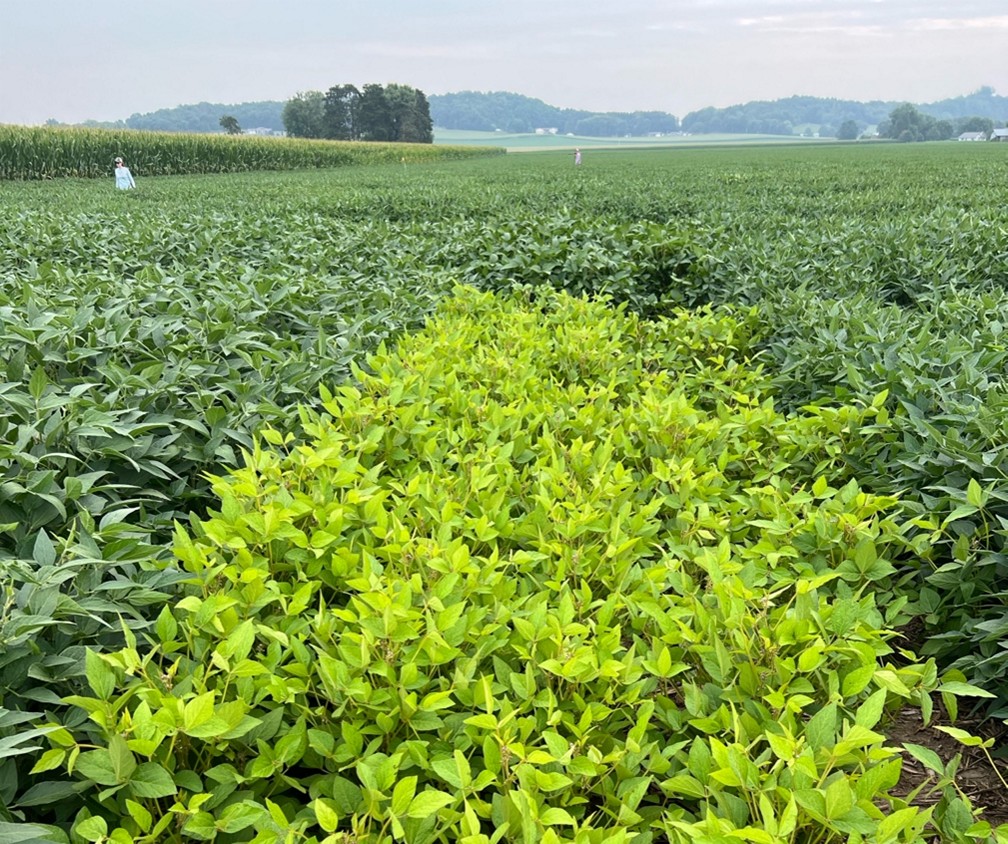
Image . Non-nodulating soybean reference crop planted next to N-fixing soybean at one of the locations (GAL) in Galesville, WI.
The non-nodulating line does not form functional nodules, which means it cannot fix atmospheric nitrogen. Because of this, its yield gives us a useful estimate of the baseline soybean yield supported by soil nitrogen alone. The nodulating isoline can form nodules and fix nitrogen, so the comparison between the non-nodulating and nodulating isolines helps estimate the yield benefit associated with nodulation and BNF at each location. A commercial soybean variety was also included at each location as the control treatment in the broader trial (Table 1). Unlike the isoline pair, the commercial variety was selected based on each location and represented the locally adapted soybean variety used at that site. Because of this, the commercial control should be viewed as a practical yield benchmark rather than a direct comparison for estimating BNF.
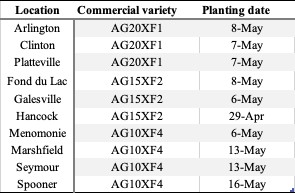
Table 1. Planting date and commercial variety at the designated location across Wisconsin in 2025.
Across all locations, the non-nodulating soybean averaged about 21.2 bu/ac, compared with 58.2 bu/ac for the nodulating isoline and 73.6 bu/ac for the commercial control. The yield difference between the non-nodulating and nodulating isolines suggests that nodulation and BNF were associated with an average yield increase of about 37 bu/ac across the 10 locations. However, the most interesting part of the story was not just the average yield difference. It was how much the non-nodulating yield varied across locations. Non-nodulating soybean yield ranged from about 2 bu/ac at Hancock to nearly 47 bu/ac at Arlington (Figure 1). This wide range suggests that the amount of soil nitrogen available to support soybean yield varied substantially across environments.
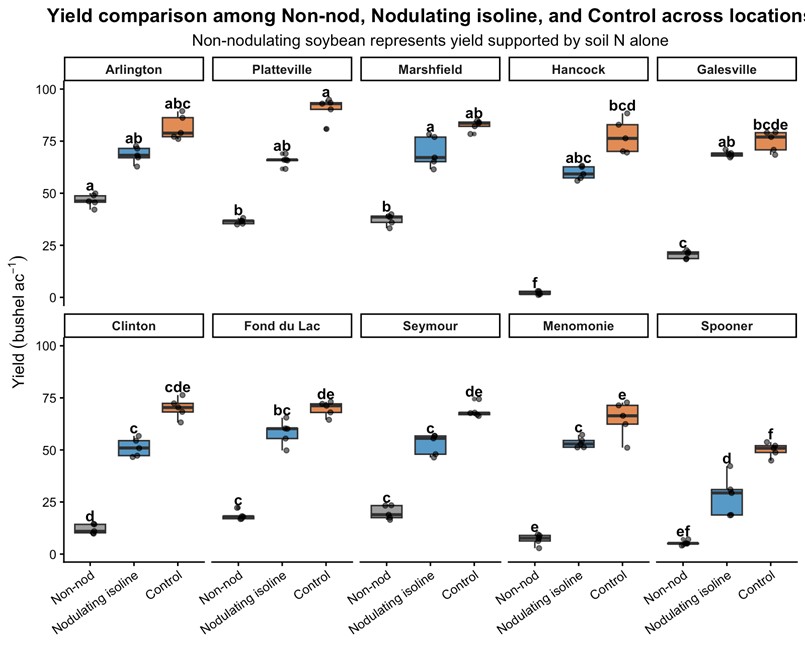
Figure 1. Soybean yield comparison among the non-nodulating line, nodulating isoline, and commercial variety across 10 Wisconsin locations in 2025. Letters indicate Tukey grouping comparisons across locations within each soybean type at α = 0.05.
One of the clearest patterns was that locations with higher non-nodulating yield also tended to have higher average nodulating soybean yield. Arlington, Marshfield, and Platteville were among the highest-yielding locations for both the non-nodulating and nodulating varieties. This suggests that these environments offered favorable conditions for both sufficient BNF and soil N supply that were able to maximize their yield potential.
However, seed composition showed that yield alone does not tell the whole story. At the highest-yielding locations, the nodulating varieties tended to have higher protein content on average across locations (Figure 2), while oil content remained relatively stable (Figure 3). This suggests that when both atmospheric and soil supplied N were sufficient to meet the N demand for maximum yield, soybean could support both high yield and higher seed N demand. In other words, higher soil available inorganic N likely helped the crop maintain seed protein while also producing high yield.
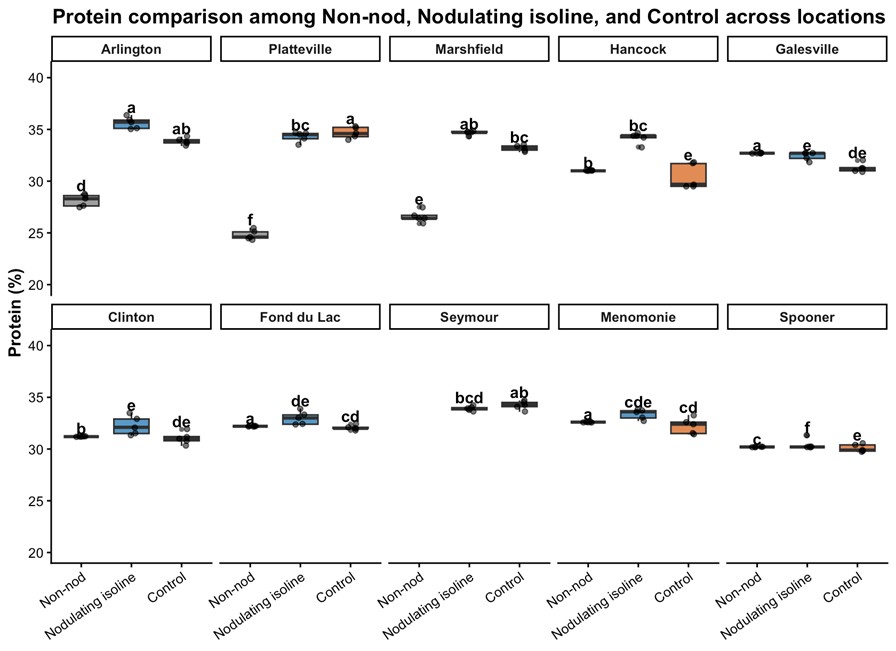
Figure 2. Soybean seed protein concentration among the non-nodulating line, nodulating isoline, and commercial control across 10 Wisconsin locations in 2025. Letters indicate Tukey grouping comparisons across locations within each soybean type at α = 0.05.
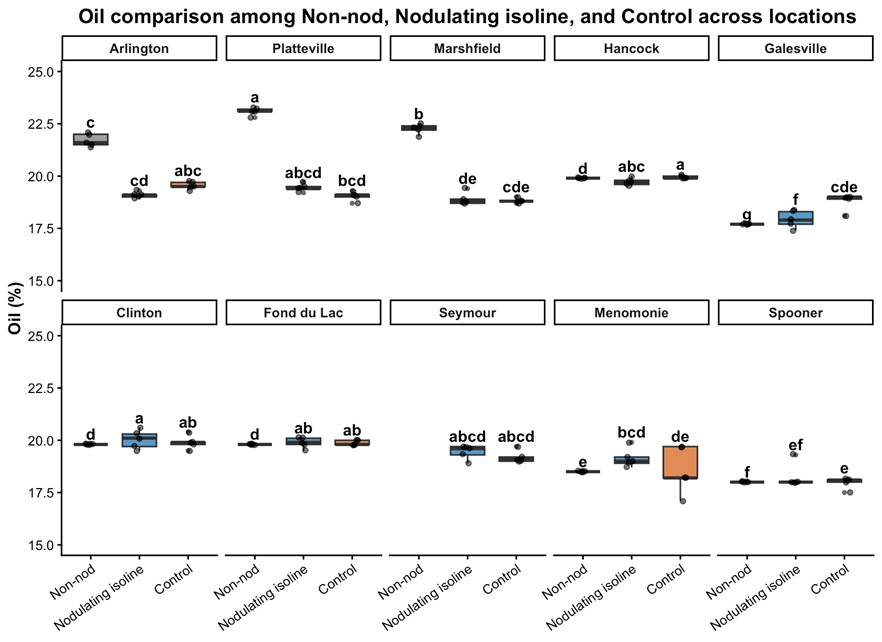
Figure 3. Soybean seed oil concentration among the non-nodulating line, nodulating isoline, and commercial control across 10 Wisconsin locations in 2025. Letters indicate Tukey grouping comparisons across locations within each soybean type at α = 0.05.
The non-nodulating line behaved differently. At these locations, where non-nodulating yield was highest, seed protein content was lower and oil content was higher compared with non-nodulating soybean at other locations. This pattern suggests that soil N alone may have supported greater seed yield at these sites, but may not have supplied enough N to maintain higher seed protein concentration. The crop could still produce more yield under favorable conditions, but without N-fixation, the additional yield may have diluted seed N concentration.
This difference between the nodulating and non-nodulating genotypes shows an interesting phenemonon. Soybean seed protein is N-rich, so maintaining protein concentration requires a strong N supply during seed fill. In nodulating soybean, BNF can provide an additional N source during reproductive growth. In non-nodulating soybean, the crop must rely entirely on soil N. If soil N supports seed production but does not fully meet the N demand of the developing seed, protein concentration may decrease. Because soybean protein and oil are inversely related, lower protein in the non-nodulating line was also associated with higher oil content.
Overall, these results show that soybean nitrogen dynamics are highly environment-dependent. Some locations had enough soil N to support moderate soybean yield even without nodulation, while other locations appeared to depend heavily on BNF. However, high soil N-supported yield did not necessarily mean that BNF was unimportant. Even when non-nodulating soybean yielded relatively well, the nodulating isoline still had a yield advantage, and seed composition suggested that fixed N may be important for maintaining seed protein in high-yield environments.
The key takeaway is that soybean nitrogen supply is not one-size-fits-all. Soil N can contribute meaningfully to soybean yield, but BNF remains a critical player in achieving high yield and maintaining seed protein. Favorable environments may help soybean access more soil N and support higher yield, but without nodulation, that yield may come with lower seed protein and higher oil. In contrast, nodulating soybean at the highest-yielding locations was better able to maintain protein while also producing high yield. These findings also goes to show the value of using non-nodulating and nodulating soybean isolines as a tool for understanding nitrogen dynamics across environments. As soybean yield potential continues to increase, understanding the balance between soil N supply and BNF will be important for improving N management recommendations and supporting profitable, high-yield soybean production. This trial is planned to be replicated once again in 2026.

Research funded by the Wisconsin Soybean Marketing Board